We were in talks with a Berlin-based founder last month. Her SaaS had crossed €1.3M ARR, the in-house marketer had quit, and the board wanted a pipeline plan by the next quarter. She had spoken to seven agencies in three weeks. Six of them quoted percentage-of-spend pricing. Three could not answer basic questions about GDPR-compliant attribution. One asked if her ICP was "B2B or B2C."
That's the German B2B SaaS agency market in 2026. Loud, crowded, and uneven. Germany's SaaS revenue is projected to reach roughly $13.8 billion, accounting for around 20 percent of total SaaS sales in Europe, with an annual growth rate of 10.5 percent according to Statista. German SMEs are showing a 42 percent year-on-year increase in SaaS utilization, according to Bitkom. When the underlying market grows that fast, every agency in Berlin adds "SaaS" to their service page, whether they have the chops or not.
This guide ranks the 12 best B2B SaaS marketing agencies in Germany for 2026. We focused on agencies that demonstrate real SaaS specialization, work fluently across the DACH region, and price in a way that aligns with the customer's revenue rather than their ad budget. No filler agencies. No US-only operators with a single German contractor and a Berlin Zoom background.
The 12 best B2B SaaS marketing agencies in Germany at a glance
How we chose these agencies
We started with the SERPs, AI Overviews, and ChatGPT recommendations for "best B2B SaaS marketing agency in Germany" and adjacent queries. That gave us a longlist of roughly 40 agencies. We then filtered against five criteria:
- B2B SaaS specialization: At least 60 percent of the agency's case studies had to be B2B SaaS, not general B2B or B2C
- DACH presence: A real Germany, Austria, or Switzerland operation, not a US agency with a single Berlin contractor
- Service depth: Enough specialization in at least one area (paid, SEO, GEO, content, ABM, design) to be a credible pick for that lane
- Verifiable proof: Public case studies, named clients, or published work we could check
- No overlap with our existing roundup: We excluded every agency already covered in our global B2B SaaS marketing agencies list so this guide adds new options rather than repeating them
The final 12 reflect what we would recommend to a German B2B SaaS founder asking us privately, not a paid placement list. magier is the only carryover from our earlier roundup, included as the design and creative specialist because that layer is usually the weakest part of a German agency engagement.
The 12 best B2B SaaS marketing agencies in Germany, reviewed
magier (Berlin)
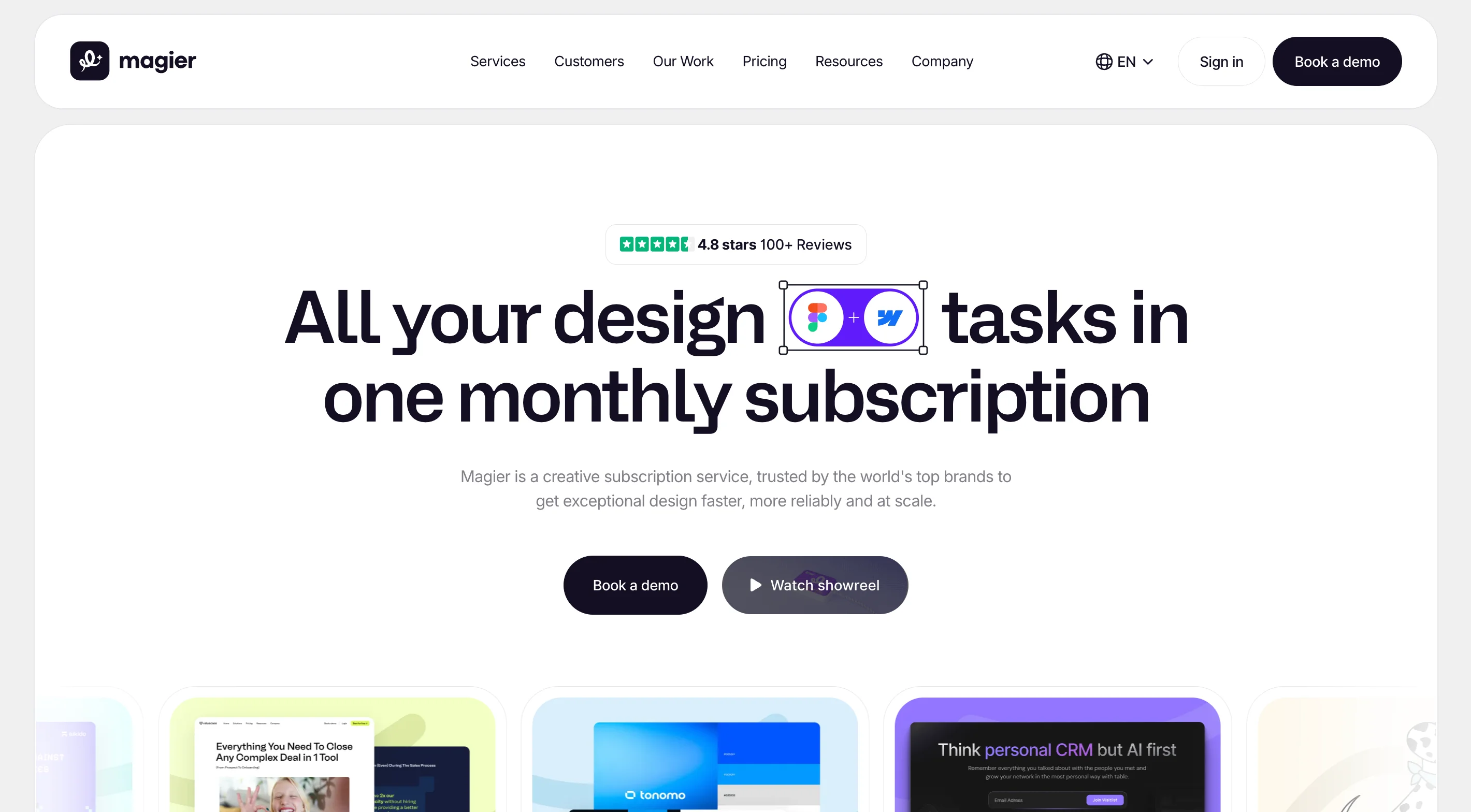
Compared to the other agencies on this list, magier is purely a design and Webflow development partner, not a full-service marketing agency. Every other agency in this guide runs full marketing programs (paid acquisition, SEO, content, outbound, ABM). magier sits on the list because design and Webflow are usually the weakest layer of any German agency engagement, and most marketing teams need a dedicated specialist for that one layer rather than bundling it into a broader retainer.
The agency operates as a design subscription service. Clients submit design requests through a simple ticket system, get a dedicated team of designers and a project manager, and receive completed work within 48 hours. Multiple rounds of revisions are included until the designs match the brief. For companies that don't have a constant need for a subscription, magier also takes on one-time projects with the same team quality and turnaround speed.
The team has worked with over 150 brands, including Upvest, Planted, Kyber, and Sparetech, and has completed over 1,000 SaaS ad creatives for B2B SaaS companies. Their specialization in SaaS web design and Webflow development means they handle both design and build under one subscription. That combination is rare in this space, and it removes the coordination overhead that comes from managing separate design and development partners.
Key services:
- Graphic design (ads, social media, presentations, brand collateral)
- Webflow design and development
- Landing page and pricing page design
- Brand identity design
- Motion design
- Pitch deck and presentation design
Best for:
- Marketing teams that already have a growth or demand gen agency (or in-house team) and need a dedicated design and Webflow partner
- Startups and scaleups (Series A+) that need ongoing, high-volume creative work with fast turnaround and predictable costs
- Companies that want both design and Webflow development from one partner instead of separate vendors
Location: Berlin, Germany (serves clients globally, fully remote)
Pricing: Starts at €2,750/month
Rating: 4.9/5 on Trustpilot (100+ reviews)
Pros:
- Flexible engagement: choose between a monthly subscription or a one-time project depending on need
- Wide range of design services under one roof (ads, landing pages, brand identity, Webflow, presentations, motion), removing the need for separate vendors for each
- Predictable pricing for Series A+ companies compared to traditional project-based agencies
- Fast turnaround (48 hours average per task) with multiple revisions included
- Clients own everything the team creates, including all design files and Webflow builds
- Webflow design and development handled by the same team, which eliminates the "design doesn't match the build" problem
Cons:
- Not a full-service marketing agency. magier does not run paid ads, SEO, content, or outbound campaigns. Companies that need both marketing strategy and execution will need to pair magier with one of the other agencies on this list
- Does not offer specialized UI/UX product design services (in-app interfaces, user research, usability testing). For deep product design work, magier needs to be paired with a dedicated product design agency
GROWSaaS (Hamburg)
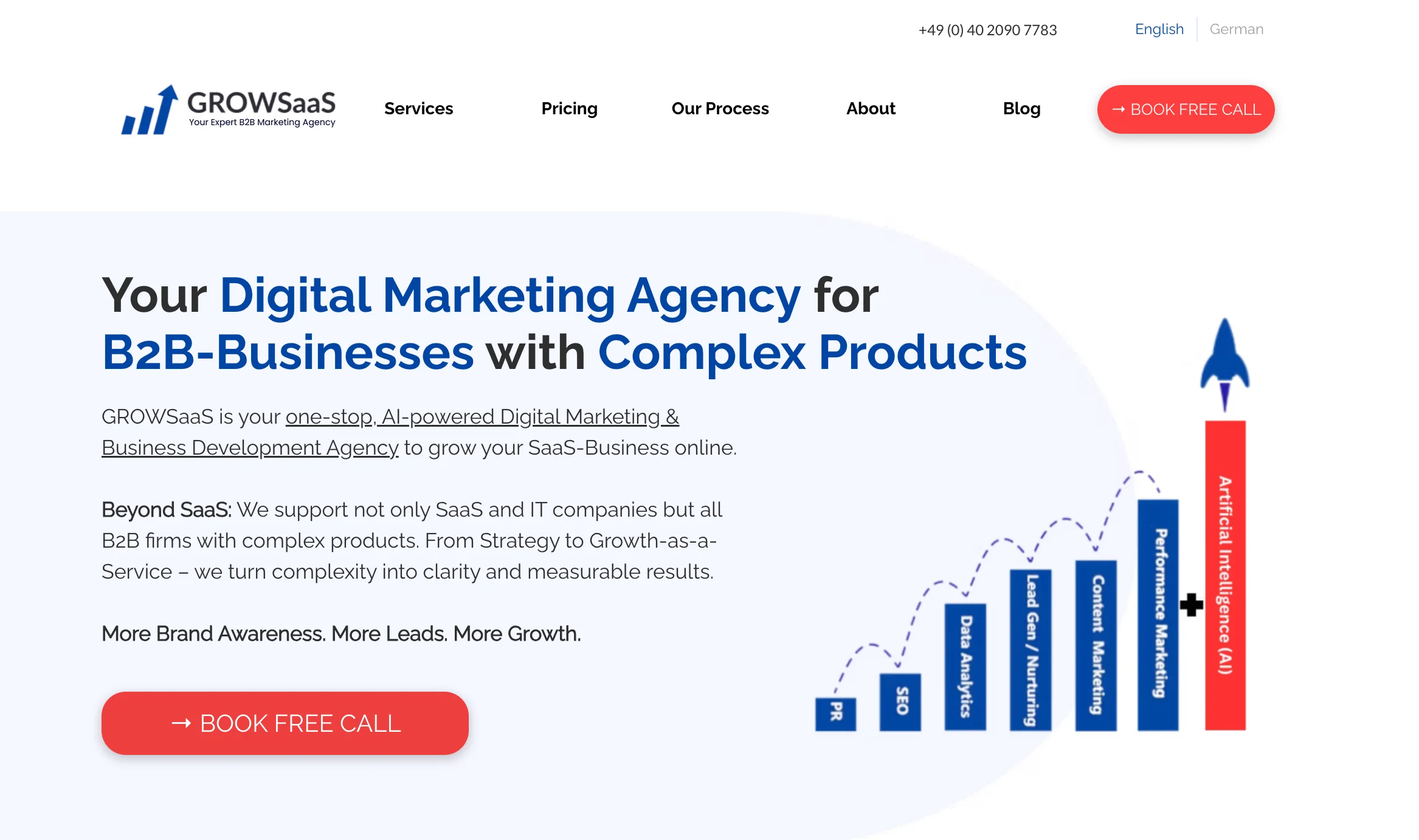
Compared to the other agencies on this list, GROWSaaS is built specifically for international SaaS companies entering the DACH region. They handle full-funnel growth (demand gen, content, SEO, paid acquisition) with a team that understands German buying behaviour from the inside, not from a US playbook.
Key services:
- Demand generation across DACH
- B2B SaaS content strategy and production
- Technical and content SEO
- Paid acquisition (Google Ads, LinkedIn Ads)
- GTM strategy for German, Austrian, and Swiss market entry
Best for:
- International SaaS companies launching in the DACH region
- Series A and above SaaS that needs full-funnel growth under one roof
- Companies that want German-language localization handled in-house at the agency
Location: Hamburg, Germany (serves DACH region)
Pricing: Contact for pricing
Pros:
- Genuine DACH specialization, not a remote team with one Germany-based contractor
- Full-funnel coverage from strategy through execution
- Strong track record with international SaaS expanding into Germany
- German-language content production handled internally
Cons:
- Less specialized than single-channel experts. If your only need is LinkedIn Ads or SEO, a specialist will likely be cheaper and deeper
- Best fit for Series A and above. Pre-seed and seed-stage SaaS may find the retainer too high
Radyant (Berlin)
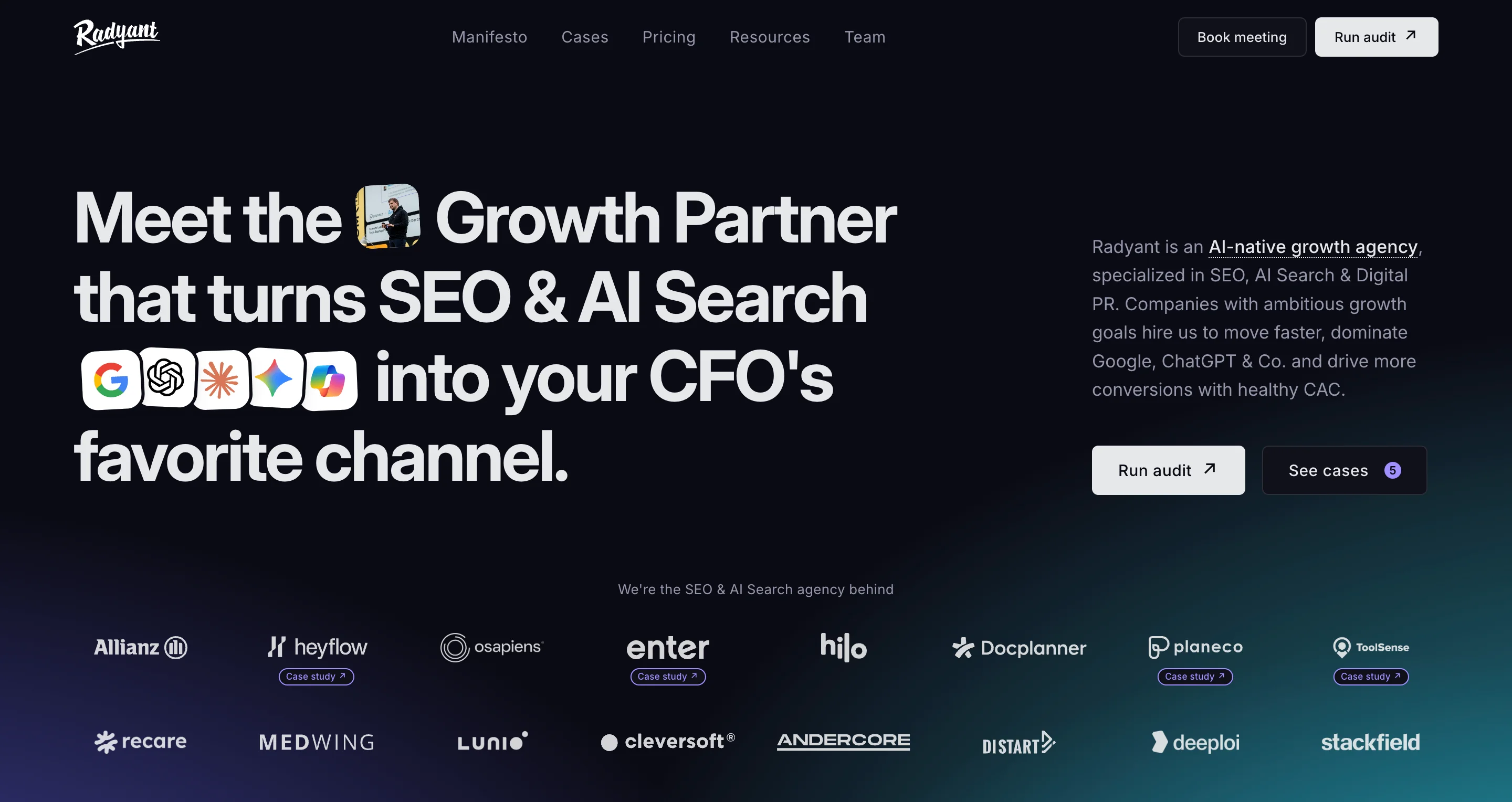
Compared to the other agencies on this list, Radyant runs SEO and AI Search as one integrated program, not two separate retainers. While most agencies still treat Google rankings and ChatGPT citations as different disciplines, Radyant treats them as one channel, optimized together from the same research base and the same senior team.
Whatever they build – whether that's content production, programmatic content clusters, mini-tools, or AI Search initiatives – the north star is always the same: pipeline impact. Every initiative has to connect to conversion, to leads, to revenue on the pipeline. That focus shapes how Radyant chooses what to build, how they measure success, and what they report back to the client.
Every content piece the Radyant team writes has to be the most accurate, most useful answer to a real question from a real buyer: technically precise, audience-specific, and genuinely adding something that isn't already out there.
Key services:
- SEO and AI Search strategy
- AI Search optimization (GEO/AEO)
- Content engineering and production
- Conversion optimization on organic pages
- Programmatic content engines
- AI search experiments
- Attribution setup for AI-driven discovery
Best for:
- Companies where organic search is a growth lever and leadership expects pipeline numbers, not traffic reports
- Teams that have hit their ceiling with paid media and want a partner who commits to commercial outcomes
- Companies looking to turn AI Search visibility into actual leads and pipeline
Location: Berlin, Germany (serves clients across DACH, the EU, and internationally)Pricing: Growth Partnership from €7,000 to €12,000 per month (12-month commitment, opt-out after month six). Projects from €10,000. Free audit at radyant.io/audit.
Pros:
- SEO and AI Search run as one program under one senior team
- Content built from real customer language, expert interviews, and internal data, not SERP rewrites
- Senior delivery on every account, from strategy to design
- Transparent monthly retainer, no hidden fees
- Attribution methodology that captures what last-click misses
- Strong DACH and EU depth across B2B SaaS, RegTech, MedTech, PropTech, and industrial B2B
Cons:
- No paid media management. Radyant reads signals from paid platforms but does not run ads.
- The Growth Partnership is a 12-month commitment. The opt-out after month six reduces the risk, but it is not a month-to-month retainer
Inno One
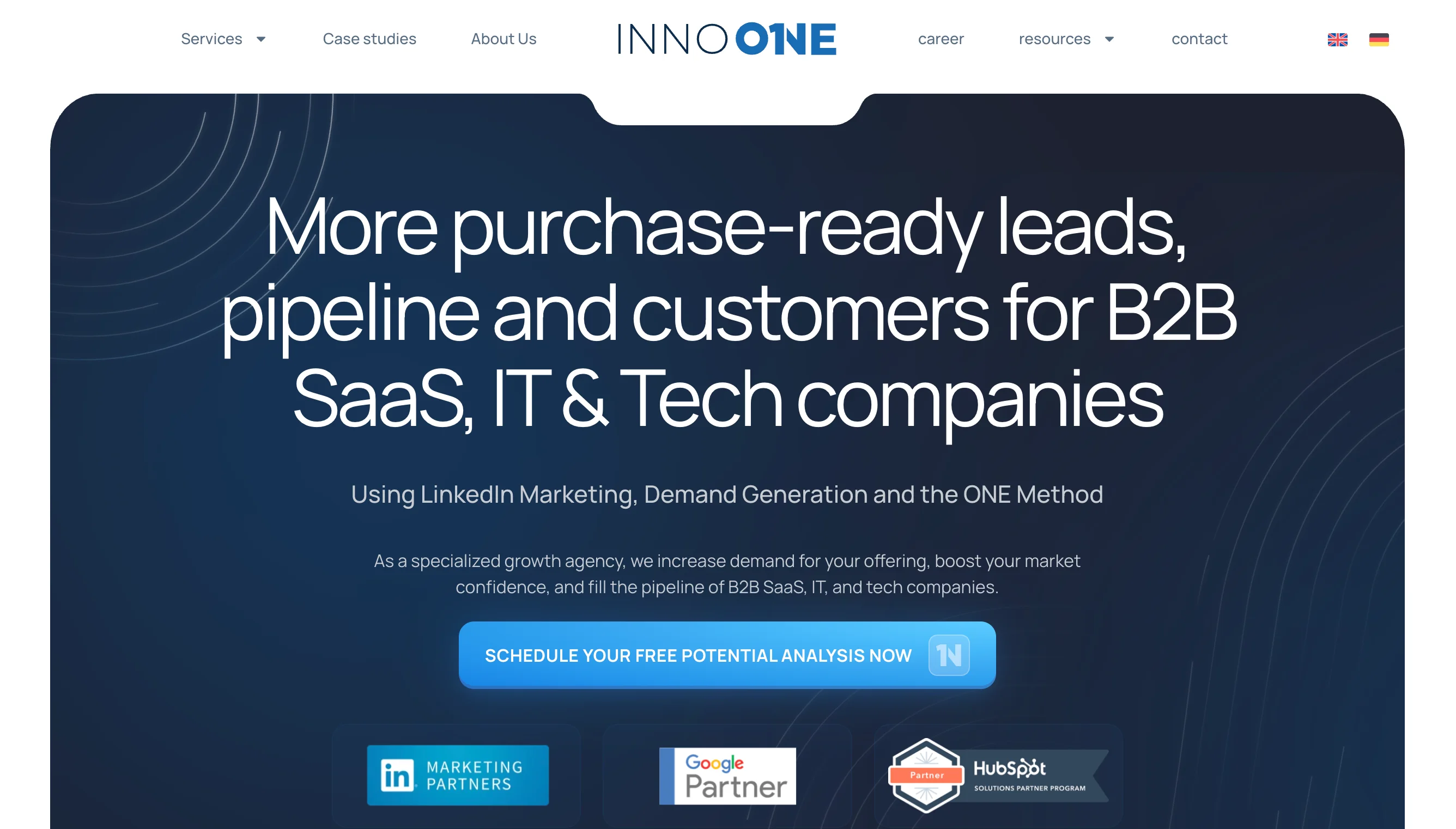
Compared to the other agencies on this list, Inno One is built entirely around LinkedIn. They combine paid LinkedIn ads, founder ghostwriting, and organic content to generate B2B pipeline, which makes them the strongest pick when LinkedIn is the buyer's primary channel.
Key services:
- LinkedIn Ads management
- Founder LinkedIn ghostwriting and content strategy
- Organic LinkedIn distribution
- B2B demand generation
- LinkedIn ABM campaigns
Best for:
- B2B SaaS where the ICP includes CMOs, VPs of Sales, RevOps leaders, or engineering decision-makers
- Founders willing to post on LinkedIn 2 to 4 times per week
- SaaS teams treating LinkedIn as a primary growth channel rather than an awareness afterthought
Location: Berlin, Germany (also serves DACH and international clients)
Pricing: Contact for pricing
Pros:
- Deep specialization on a single channel that matters for most B2B SaaS in 2026
- Founder branding integrated with paid amplification, not treated separately
- Strong understanding of DACH-specific LinkedIn behaviour and creative norms
- Pipeline-focused reporting
Cons:
- LinkedIn-only focus means they are not the right pick if your ICP lives elsewhere (developer communities, regulated industries with low LinkedIn activity)
- Underperforms when founders are not willing to publish consistently
Suxeedo (Cologne)
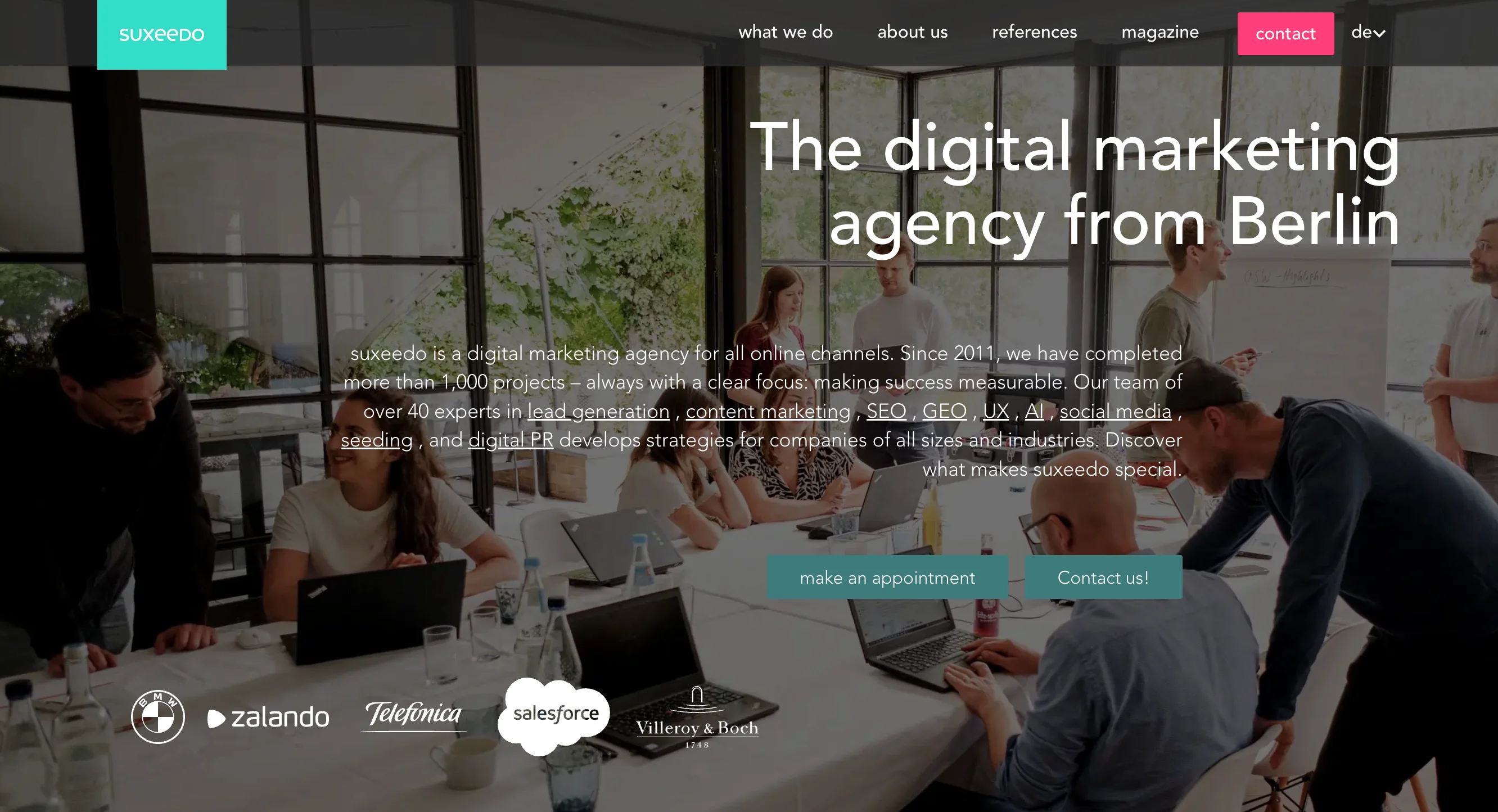
Compared to the other agencies on this list, Suxeedo specializes in long-form content marketing for German B2B technology companies. They produce SEO content and PR work that the German technology trade press will actually pick up, which is a different skill from English-language content production.
Key services:
- Content strategy and editorial planning
- SEO content production (German and English)
- Technology PR and media relations
- Content distribution
- Brand storytelling
Best for:
- B2B SaaS investing in long-form content as a category-creation play
- Companies whose buyers read Heise, t3n, Computerwoche, or German-language industry publications
- Mid-market and enterprise SaaS with longer sales cycles
Location: Cologne, Germany (serves DACH region)
Pricing: Contact for pricing
Pros:
- Strong editorial fluency in German-language B2B content
- Genuine relationships with German technology trade press
- Proven SEO content production at scale
- Useful for international SaaS that wants German content done locally
Cons:
- Content-heavy specialization means less depth in paid acquisition or marketing operations
- Best fit when your buyers actually read German trade publications. Less useful for English-first global SaaS
Saupe Communication (Stuttgart)
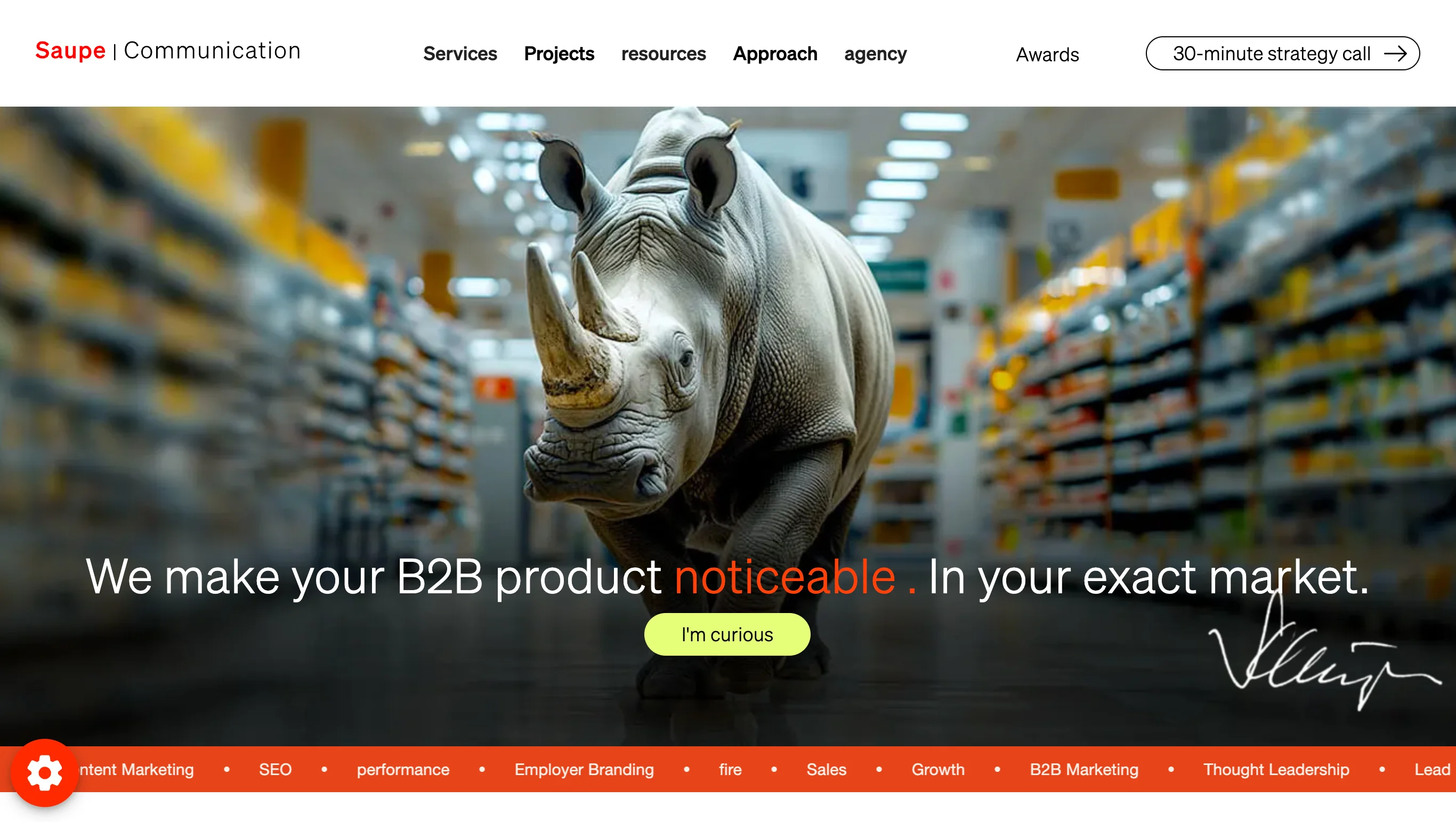
Saupe Communication SaaS marketing agency hero showing a rhinoceros walking through a supermarket aisle with the headline "We make your B2B product noticeable. In your exact market."
Compared to the other agencies on this list, Saupe Communication handles enterprise B2B with complex, multi-stakeholder sales cycles. They are the pick for selling to procurement-led buyers in industrial software, manufacturing tech, and the German Mittelstand, where Berlin agencies usually lack the right context.
Key services:
- B2B branding and positioning for complex products
- Growth marketing for enterprise SaaS
- Sales enablement collateral
- Long-form case study production
- Lead generation for multi-stakeholder deals
Best for:
- Enterprise SaaS with 9-month-plus sales cycles
- Industrial software and manufacturing tech selling into Mittelstand
- SaaS selling to procurement, IT, and compliance buyers in the same deal
Location: Stuttgart, Germany (serves DACH and international Mittelstand)
Pricing: Contact for pricing
Pros:
- Genuine Mittelstand fluency that Berlin and Munich agencies usually lack
- Comfortable with multi-stakeholder buying committees
- Strong case study production capability
- Sales enablement built in, not bolted on
Cons:
- Less startup-friendly. If you are pre-Series A or moving fast, the pace and processes may feel heavy
- Higher retainers than channel-specific specialists
Growably (Berlin)
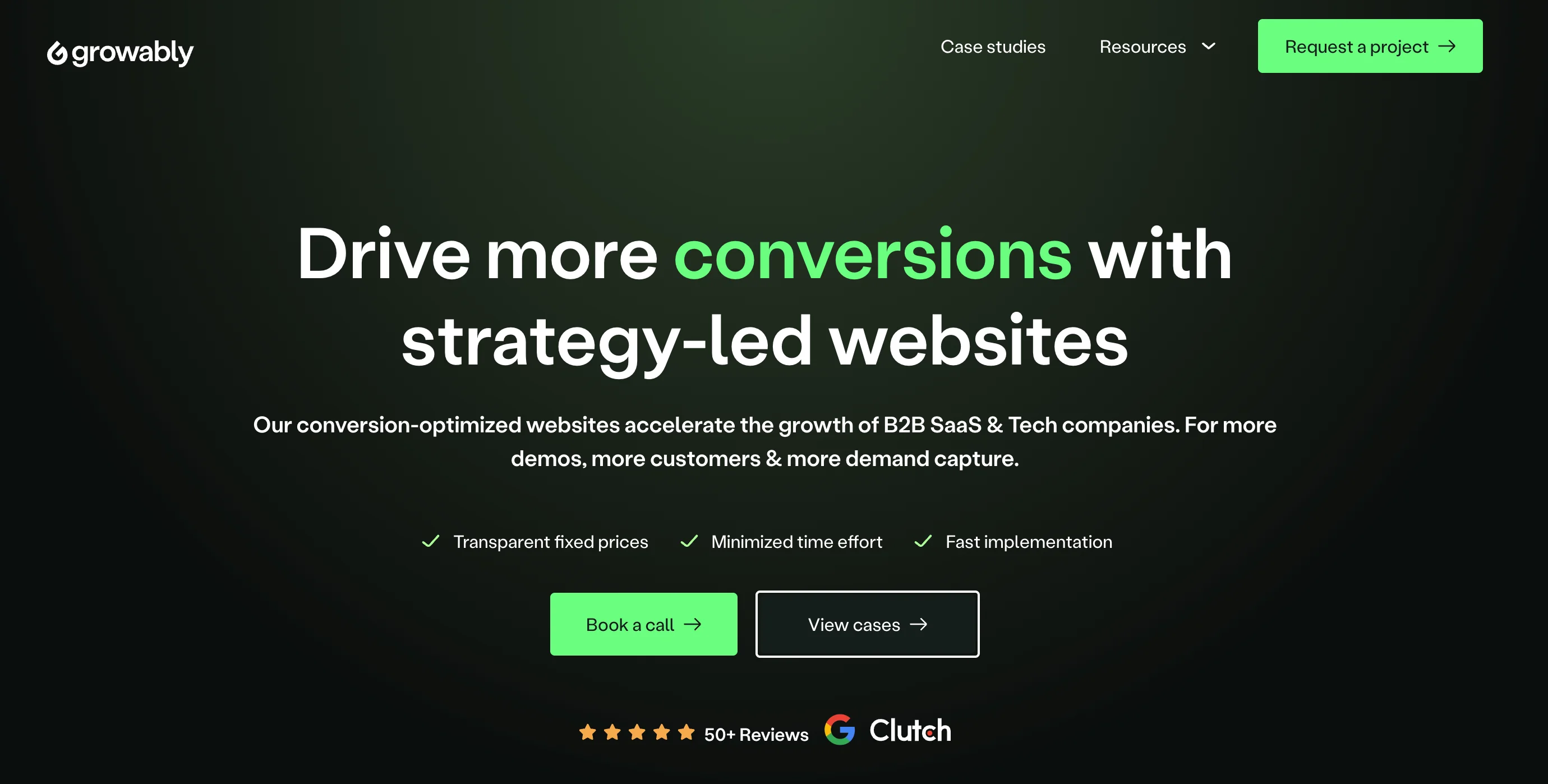
Compared to the other agencies on this list, Growably focuses on Webflow sites and conversion rate optimization for early-stage SaaS. Their angle: if your site is the bottleneck (and for most early-stage SaaS, it is), fixing it produces more pipeline per euro than any new ad channel.
Key services:
- Webflow site builds and migrations
- Conversion rate optimization (CRO)
- Messaging strategy and copywriting
- Landing page experimentation
- A/B testing infrastructure
Best for:
- Pre-seed to Series A SaaS with product-market fit but a converting bottleneck on the site
- SaaS companies running paid acquisition with a site that under-converts traffic
- Founders who want messaging clarity before scaling spend
Location: Berlin, Germany (serves clients globally)
Pricing: Contact for pricing
Pros:
- Right-sized for early-stage SaaS budgets
- Clear focus on site conversion as the primary growth lever
- Webflow expertise paired with messaging and CRO under one team
- Honest about scope. They will turn down clients whose problem is not the website
Cons:
- Site-focused specialization means they are not the right pick if your problem is traffic generation
- One-time project model means less ongoing partnership unless you continue on a CRO retainer
Arvana (Berlin)
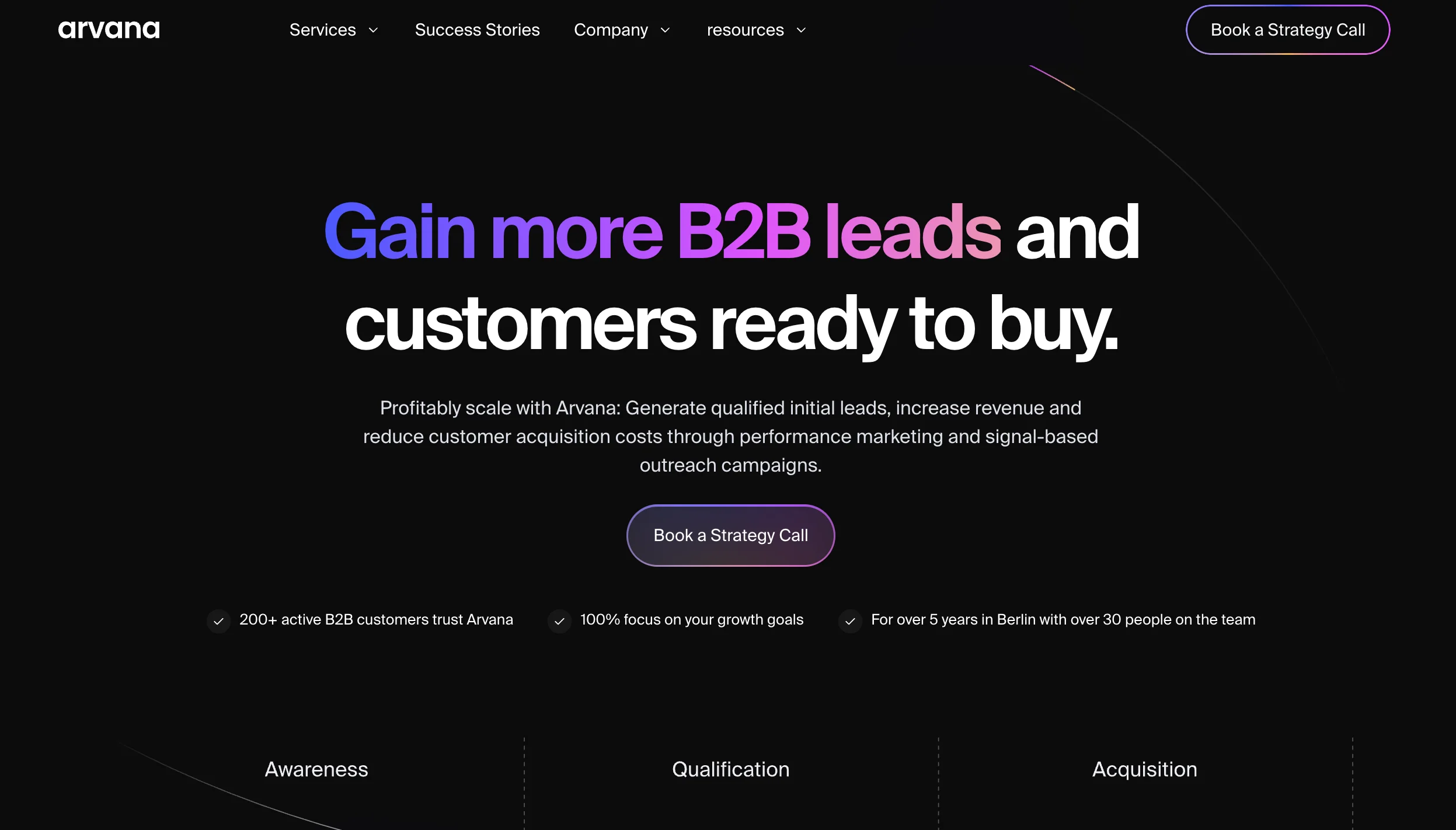
Compared to the other agencies on this list, Arvana runs outbound and B2B lead generation as one combined motion (cold email, LinkedIn outreach, paid social). They fill demo calendars for SaaS that are past the messaging stage and have a sales team ready to close.
Key services:
- Cold outbound (email and LinkedIn)
- Demo booking and pipeline generation
- Paid social for B2B
- Account-based marketing for mid-market
- Lead qualification
Best for:
- B2B SaaS past Seed stage with a working sales team
- Companies needing 5 to 15 qualified demos per week
- SaaS with a defined ICP and a closing process
Location: Berlin, Germany (serves DACH and international SaaS)
Pricing: Contact for pricing
Pros:
- Opinionated about what "qualified" means. Will refuse to book meetings that miss their bar
- Combined outbound, LinkedIn, and paid social under one team
- Strong fit for SaaS where founder-led sales is transitioning to a sales team
Cons:
- Outbound only works when product, message, and sales process are already strong. They will tell you that, but pre-product-market-fit teams should fix those first
- Less useful for SaaS where the buyer rejects cold outreach (some developer audiences, regulated industries)
Jolly Marketer (Berlin)
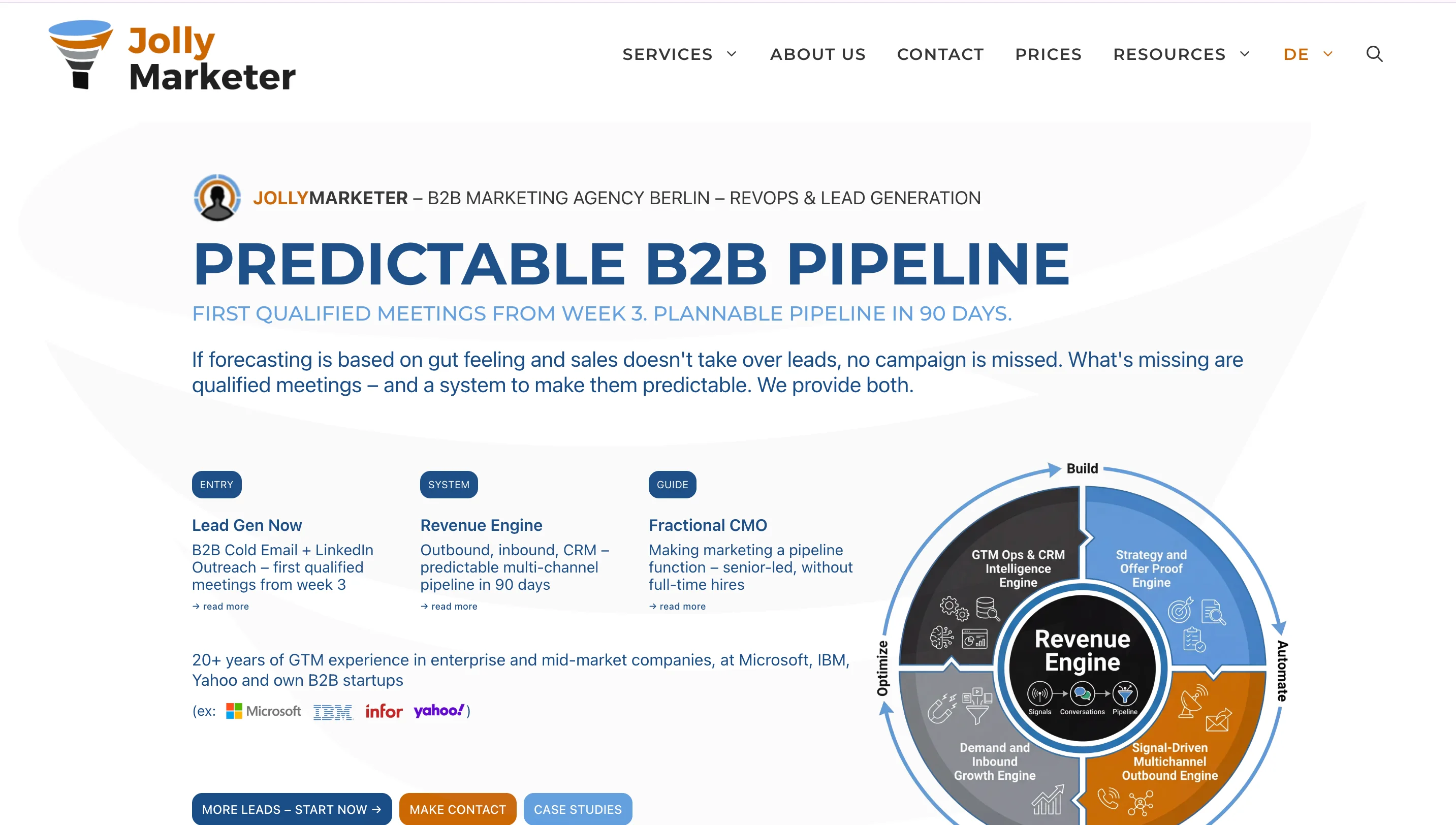
Compared to the other agencies on this list, Jolly Marketer specializes in AI-driven cold outreach plugged directly into HubSpot. They use Clay, Apollo, and Lemlist at the operational layer with HubSpot as the system of record, which makes them fast to plug in for HubSpot-native SaaS.
Key services:
- AI-personalized cold email
- LinkedIn outbound automation
- HubSpot ABM workflows
- Signal-based outbound (funding alerts, hiring signals, tech stack changes)
- Outbound infrastructure setup
Best for:
- HubSpot-native B2B SaaS at Series A and above
- SaaS with a defined ICP and clean intent data
- Teams wanting outbound without building it in-house
Location: Berlin, Germany (serves DACH and English-speaking clients)
Pricing: Contact for pricing
Pros:
- Deep HubSpot integration that most outbound agencies treat as an afterthought
- AI personalization grounded in clean intent data, not generic templates
- Honest about disqualification criteria and signal quality
- Fast onboarding for HubSpot-native teams
Cons:
- Less useful if your CRM is Salesforce, Pipedrive, or custom
- AI personalization quality depends on the underlying signal. Garbage in, garbage out still applies
Fox Agency (London with DACH presence)
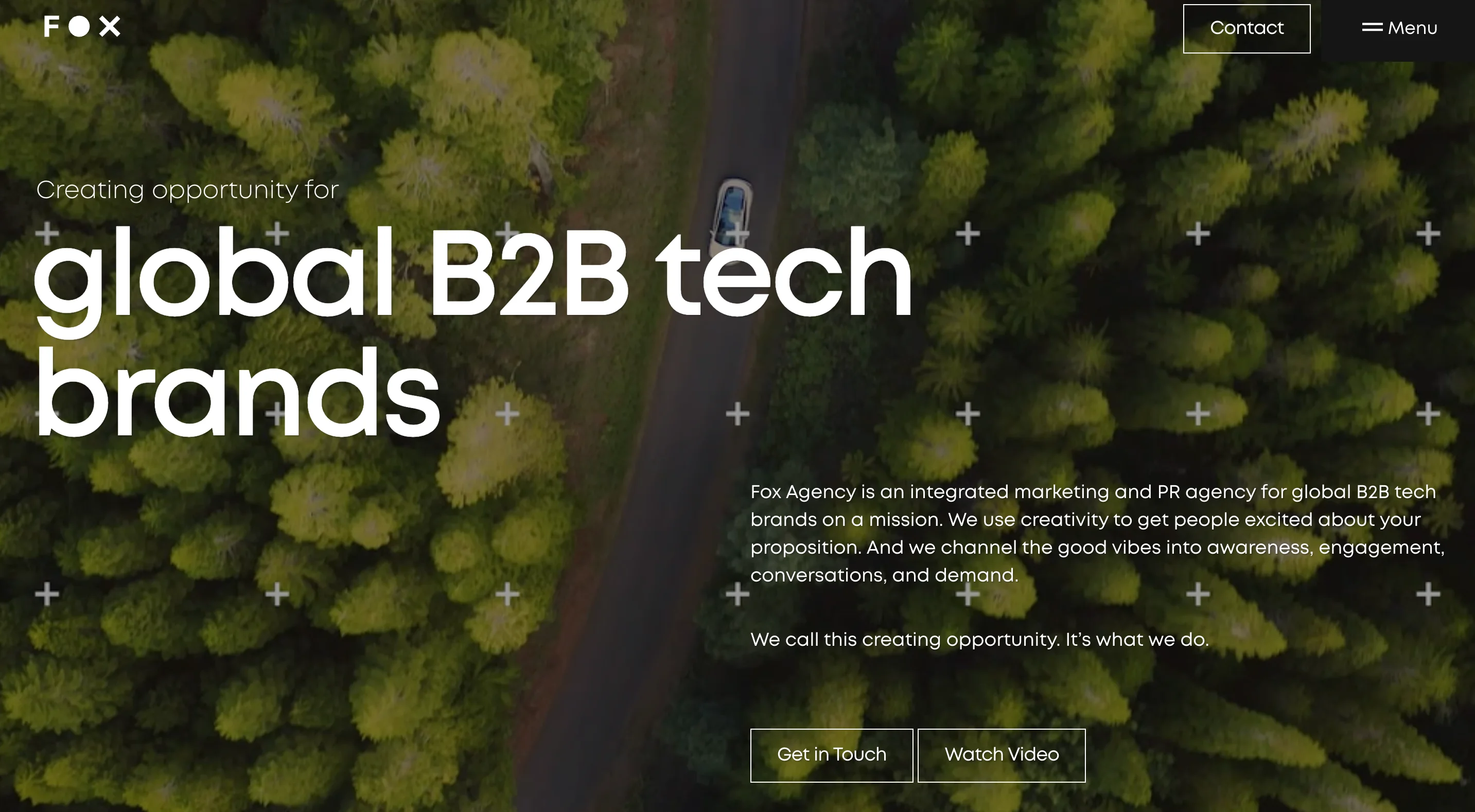
Compared to the other agencies on this list, Fox Agency is a London-headquartered B2B technology agency with real DACH coverage. They handle integrated programs across Germany, the UK, and the Nordics, which makes them a fit for SaaS marketing across multiple European markets under one partner.
Key services:
- B2B branding and positioning
- Paid media across European markets
- Content marketing and demand generation
- Integrated campaign management
- ABM for enterprise SaaS
Best for:
- Growth-stage SaaS marketing across multiple European countries
- Companies wanting brand consistency without three regional agency partners
- B2B technology brands targeting both UK and DACH
Location: London, UK with DACH and Nordics coverage
Pricing: Contact for pricing
Pros:
- Multi-market European coverage under one team
- Strong brand and integrated campaign capability
- Enterprise-grade processes for larger SaaS
- Proven case studies with European B2B technology brands
Cons:
- DACH presence is smaller than UK operations. Verify how many team members on your account are Germany-based or German-native
- Higher minimum retainers than DACH-only specialists
SaaStorm (Berlin)
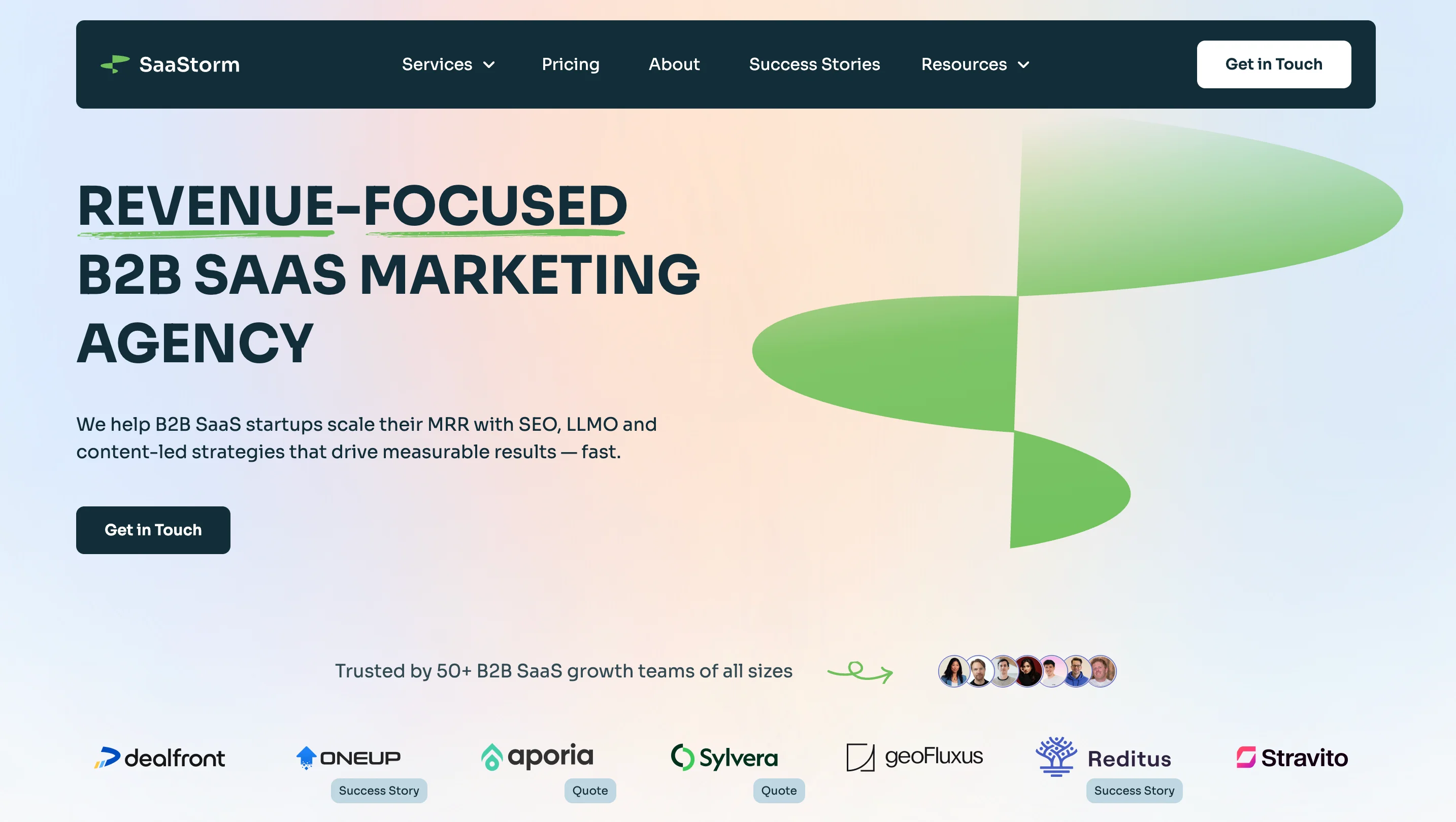
Compared to the other agencies on this list, SaaStorm focuses on SaaS marketing operations and lifecycle, which is the part of growth marketing that does not fit cleanly into "paid" or "content" buckets. They are the pick when your bottleneck is operational capacity rather than strategy or channel execution.
Key services:
- SaaS marketing operations
- Lifecycle and email programs
- HubSpot or Salesforce administration
- Marketing automation
- Pipeline reporting and attribution
Best for:
- B2B SaaS at Series A and above where the in-house marketing team is one or two people
- Companies where pipeline reporting cannot answer "which campaigns produced revenue last quarter"
- SaaS teams that need someone to own the operational layer
Location: Berlin, Germany (serves international SaaS)
Pricing: Contact for pricing
Pros:
- Owns the unglamorous, high-leverage operational layer most agencies skip
- Fixes attribution and reporting before running new campaigns
- HubSpot and Salesforce fluency
- Frees the in-house team to focus on strategy and content
Cons:
- Not a creative or strategy-led agency. If you need brand and messaging work, pair with another partner
- Less useful if your operational stack is already strong
Native Digital
Compared to the other agencies on this list, Native Digital is the paid acquisition specialist for B2B SaaS in Germany. They focus on performance across Google Ads, LinkedIn Ads, Meta retargeting, and conversion optimization, with the diagnostic discipline to distinguish a paid acquisition problem from a conversion problem.
Key services:
- Paid media management (Google, LinkedIn, Meta)
- Performance marketing strategy
- Conversion optimization
- Paid attribution setup
- Creative testing infrastructure
Best for:
- B2B SaaS with a working ICP, converting product, and need to scale paid acquisition
- Seed-plus and Series A SaaS where paid spend is the primary lever
- Companies that want a paid-only specialist rather than a generalist
Location: Berlin and remote (serves DACH and English-speaking SaaS)
Pricing: Contact for pricing
Pros:
- Diagnostic discipline. Asks to see CAC payback math before signing
- Cross-channel paid expertise (not LinkedIn-only or Google-only)
- Conversion optimization built into the retainer, not sold separately
- Revenue-focused reporting
Cons:
- Paid-only focus means SEO, content, and brand work need a separate partner
- Less useful for pre-revenue SaaS still figuring out ICP and messaging
Best B2B SaaS marketing agencies in Germany by specialty
Different agencies solve different problems. Match the specialty to your single biggest growth bottleneck.
What B2B SaaS marketing in Germany actually looks like
B2B SaaS marketing in Germany is the practice of acquiring and retaining business customers for software products in the DACH region. It differs from US-style SaaS marketing in three ways: longer sales cycles, stricter GDPR data limits, and a stronger preference for proof-heavy content over hype-driven campaigns.
Here's the part most US-trained marketers underestimate. German B2B buyers read more before they buy. They forward your white paper to two colleagues before they book a demo. They expect a written quote, not a "let's hop on a call." They also expect a vendor to know what the GVO, the EU AI Act, and Schrems II actually mean for their data stack.
Most US playbooks miss this. They optimize for speed of conversion when the German buyer optimizes for confidence of conversion. Those are not the same thing.
The right agency in Germany understands these differences instinctively. They write German-language assets (or commission them), build attribution that survives a consent rejection, and write case studies that are specific enough to be useful, not just decorative.
Paid ads as a B2B SaaS growth strategy in Germany
Most B2B SaaS marketers in Germany are underspending on paid ads, overspending on the wrong channels, or both. The reason is rarely budget. It is usually attribution.
When GDPR-consent reduces tracked conversions by half (and it often does), the paid ads dashboard looks worse than the actual business outcome. Founders see the gap, blame the channel, and pull spend. Six weeks later, pipeline drops and they cannot trace why. That sequence repeats more often in DACH than in any other region we work in.
Here's how to think about it instead.
{{ad-library}}
Why most B2B SaaS paid ads in Germany fail
Three failure modes, in order of how often we see them:
- The creative is English-only: A LinkedIn ad written in English performs 30 to 50 percent worse in Germany than the same idea in German. Most US-trained marketers do not localize because the buyer speaks English. The buyer ignoring an English ad in their German LinkedIn feed is not the same as the buyer not speaking English
- The targeting is too broad: "B2B decision-makers in DACH" is not an audience. It is a thought. Working audiences are usually 5,000 to 50,000 people, defined by job title, company size, and a third filter (technology stack, recent funding event, hiring signal)
- There is no offline conversion pipeline: Most B2B SaaS sales happen days or weeks after the ad click, often in a different browser. Without offline conversion tracking back to LinkedIn or Google, the algorithm optimizes for the wrong signal
Fix those three, and most paid ads programs in Germany double their reported pipeline within a quarter. Without metrics changing. Just measurement changing.
LinkedIn Ads in Germany
LinkedIn is the default paid channel for most B2B SaaS in Germany. Click costs are high (€8 to €25 per click is normal for senior audiences), but the targeting precision compensates when the ICP is sharp.
What works in DACH on LinkedIn:
- Thought leader ads (sponsoring a founder or executive's organic post) outperform brand-page promoted content by a wide margin
- Document ads for gated white papers and reports drive cost-per-lead 30 to 50 percent below conversation ads in most accounts
- Bottom-of-funnel retargeting with case study video or product demo content produces 2 to 4 times the booked meetings per euro vs cold prospecting
What rarely works:
- Lookalike audiences in DACH (the LinkedIn dataset is shallower than in the US)
- Video ads over 30 seconds without subtitles
- US-style "book a 15-minute call" CTAs to cold audiences
Google Ads for B2B SaaS
Google Ads is the bottom-of-funnel channel. The buyer who searches "best CRM for German SaaS startup" already has intent. Most B2B SaaS underspend on this exact moment.
Three Google Ads plays that produce pipeline in DACH:
- Branded keywords including competitor brand defence (cheap, defensive, often ignored)
- Commercial-intent keywords ("best [category] software," "[category] software pricing," "alternative to [competitor]")
- Search retargeting combined with LinkedIn retargeting for buyers who searched once and then went silent
Meta and Reddit retargeting for the dark funnel
The dark funnel is where most B2B SaaS buyers live. They listen to podcasts, lurk on Reddit, scroll LinkedIn without engaging, and read newsletters. None of this shows up in attribution.
Meta and Reddit retargeting catches these buyers at moments your CRM cannot see. Cheap CPMs, low expectations on direct attribution, but real lift in branded search and direct traffic over 90-day periods. Run them as awareness layers, not pipeline channels.
G2 and Capterra placements
For B2B SaaS where the buyer compares 3 to 5 vendors on a review site before buying, G2 and Capterra ads convert at rates that most paid channels cannot reach. The intent is highest in the funnel. The cost is real (€2,000 to €15,000 per month is typical), but for the right category, the math works fast.
If your category has fewer than 10 listed competitors on G2, the placement is probably underpriced. If it has 50-plus, the placement is usually overpriced.
The role of ad creative
This is where most B2B SaaS programs leave money on the table. The targeting is fine. The bidding is fine. The creative is generic.
In a DACH paid program, the creative is the highest-leverage variable you can change. Refreshing creative every 2 to 4 weeks (with at least 6 variants live at any time) produces compounding lift. Running the same three ads for 6 months produces audience fatigue, frequency cap problems, and the kind of slow performance decline that founders blame on "the channel."
This is one reason magier exists as a specialist on this list. Most agencies bundle creative into the retainer and produce one or two ads per quarter. That cadence is not enough.
What CAC payback looks like for paid ads in DACH
Realistic benchmarks for B2B SaaS paid ads in Germany, based on agency work we have visibility into:
- LinkedIn Ads: CAC payback of 14 to 24 months is typical at €5K to €15K monthly spend
- Google Ads: CAC payback of 6 to 14 months on commercial-intent keywords; longer on broader terms
- G2 and Capterra: CAC payback of 8 to 18 months, with higher LTV because review-site buyers are further down the funnel
- Meta and Reddit retargeting: Not directly attributable. Measure as a lift on branded search and direct over 90-day windows
If an agency promises sub-6-month CAC payback on LinkedIn Ads to cold audiences, ask for the case study. Then ask for the next two. The first one is sometimes a one-off.
How to choose a B2B SaaS marketing agency in Germany
The decision matters more than the shortlist. Use this framework.
Match the agency's primary specialty to your biggest growth problem
Generalists sound flexible. They are usually mediocre at everything and excellent at nothing. If your bottleneck is paid acquisition, hire a paid acquisition specialist. If it is SEO, hire an SEO specialist. If your site converts at 0.5 percent, hire a CRO and Webflow specialist before you spend another euro on traffic.
Verify B2B SaaS specialization, not just B2B
B2B is a category. B2B SaaS is a discipline. The agency that sells to industrial manufacturers understands one buying motion. The agency that sells to mid-market software companies understands a different one. Ask what percentage of their clients are B2B SaaS specifically. If it is below 60 percent, weigh that.
Demand revenue-focused case studies
Traffic is not revenue. Impressions are not revenue. Even MQLs are not revenue. Ask for case studies that include ARR, pipeline value, or CAC payback. If they cannot share those, they probably do not measure their work that way.
Confirm who actually works on your account
The senior strategist who runs the sales call is often not the person doing your work. Ask, in writing, who your day-to-day contact will be, what their tenure is, and how many accounts they manage. Above 8 accounts per manager is a flag.
Insist on flat-fee or hybrid pricing
Percentage-of-spend pricing rewards bigger ad budgets, not better outcomes. The agency earns more when you spend more, regardless of whether spending more was the right call. Flat-fee retainers align incentives around efficiency. Hybrid models (base retainer plus performance bonus) work when the performance bonus is tied to revenue, not impressions.
Test their understanding of GDPR and DACH-specific constraints
Ask: "How do you handle attribution when consent is rejected?" The right answer involves server-side tracking, offline conversion API, and a CRM-first attribution model. The wrong answer involves "we'll figure it out" or "most tools handle that automatically." They do not.
Ask about CRM integration
If reporting stops at the ad platform dashboard, the agency cannot prove pipeline impact. Real attribution requires HubSpot or Salesforce integration. Confirm this in writing during onboarding.
Evaluate contract length and exit clauses
Month-to-month with a 30-day exit is the new standard for confident agencies. A 12-month minimum with no performance clause is a protection mechanism for the agency, not the client. Negotiate it down or walk away.
How much do B2B SaaS marketing agencies in Germany cost?
B2B SaaS marketing agencies in Germany typically charge €3,000 to €18,000 per month. Early-stage SaaS at €1M to €5M ARR usually pays €3,000 to €6,000 monthly. Growth-stage SaaS at €5M to €20M ARR typically pays €6,000 to €12,000. Enterprise SaaS pays €12,000 and up.
A few notes on pricing models, in plain language:
- Flat-fee retainer. Preferred. The agency earns the same whether your budget is €30K or €60K per month. Their only path to justify the fee is to make your existing budget work harder
- Percentage of spend. Avoid. The agency earns more when you spend more. Your CAC can rise while their revenue from you doubles
- Performance-based. Works when the metric is revenue or pipeline. Risky when the metric is leads, because lead quality varies wildly
- Hybrid (base plus bonus). Good balance, provided the bonus is tied to a real revenue metric
Red flags when hiring a B2B SaaS marketing agency in Germany
Avoid agencies that show any of these signs during evaluation.
- Percentage-of-spend pricing: Their revenue grows when your CAC grows. The incentives are misaligned by design
- Twelve-month minimum with no performance clause: They are protecting themselves, not committing to your outcome
- Vanity metrics in case studies: "Traffic grew 300 percent" means nothing if pipeline stayed flat. Look for ARR, SQO, or CAC payback
- Bait-and-switch staffing: Senior strategists during sales, junior account managers after signing. Confirm in writing who does the actual work
- No SaaS-specific case studies: They will learn on your budget. Require proof of relevant work
- Promises of results in 30 days: Paid media needs 4 to 8 weeks. SEO needs 3 to 6 months minimum. Anyone faster is either lucky or lying
- No CRM integration: Without HubSpot or Salesforce integration, attribution stops at the platform dashboard and pipeline claims are unverifiable
- No German-language capability: If your buyers read German content, an English-only agency limits half your TAM
- The same playbook for every client: "We do this for everyone" means strategy is missing. Your business needs adaptation, not template
- They cannot describe your ICP back to you: If the agency starts campaigns without a clear ICP brief, they are guessing with your money
Agency vs in-house: which one fits your German SaaS team?
The decision depends on stage, budget, and the kind of marketing work you need done.
Most German B2B SaaS teams at Series A and below use agencies. The fully in-house model usually becomes economical only at €20M+ ARR, or when the founder is convinced that marketing is the long-term strategic moat and wants brand knowledge living inside the company.
The hybrid model is common at Series A to B. In-house owns brand, content strategy, and product marketing. Agencies own paid media, SEO execution, and CRO. We see this setup in roughly half of the funded SaaS teams we speak to in Berlin.
B2B SaaS marketing trends shaping 2026 in Germany
A few shifts that matter for the agency choice.
AI search is real, and German buyers use it
ChatGPT, Perplexity, and Google's AI Overviews are now part of the B2B buyer journey, including in DACH. Agencies that optimize for Generative Engine Optimization and Answer Engine Optimization are pulling ahead of those that only optimize for traditional SEO.
Capital efficiency replaced growth-at-all-costs
German VCs were always more conservative than US VCs on this. Now the US is catching up. The result: agencies that prove CAC payback and LTV-to-CAC ratios are easier to defend to a board than agencies that report on traffic and impressions.
The dark funnel is wider in DACH than in the US
German B2B buyers do more research in untracked channels (podcasts, communities, peer conversations) before they ever fill a form. Attribution stacks that only measure trackable touches systematically undercount marketing's contribution.
Founder-led distribution beats SEO for the first 18 months
For early-stage German SaaS, a founder who posts on LinkedIn 3 times per week, with the agency ghostwriting and amplifying, often outperforms a 6-figure SEO investment. This holds until the brand has enough trust that organic search converts at acceptable rates.
The EU AI Act adds a layer to martech procurement
Enterprise buyers in DACH are starting to ask about AI usage in marketing tools (HubSpot, Clay, etc). Agencies that can answer these questions for you reduce sales friction.
A closing note
The right B2B SaaS marketing agency can compound your growth in ways an in-house team rarely matches at the same stage. The wrong one burns budget while showing dashboards full of green metrics that never reach revenue.
If you take one thing from this guide, let it be this. Match the agency's primary specialty to your single biggest growth problem. Then verify their B2B SaaS depth, their revenue-focused case studies, and their pricing model. Most other variables follow from those three.
If the gap in your stack is ad creative or Webflow design rather than full-funnel growth, magier handles that one layer with a B2B SaaS focus most generalist design agencies miss.
{{redirect}}
Frequently asked questions
What is a B2B SaaS marketing agency?
A B2B SaaS marketing agency is a specialist firm that helps software-as-a-service companies acquire and retain business customers. The work usually includes demand generation, SEO, paid media, content marketing, and marketing operations, with frameworks built specifically for recurring revenue models and long sales cycles.
How much do B2B SaaS marketing agencies in Germany cost?
B2B SaaS marketing agencies in Germany typically charge between €3,000 and €18,000 per month. Pre-seed and seed-stage SaaS usually pays €1,500 to €3,500. Early growth-stage pays €3,000 to €6,000. Enterprise SaaS pays €12,000 and up. Flat-fee retainers are the most common structure.
What is the best B2B SaaS marketing agency in Germany?
The best agency depends on the growth problem you are solving. For DACH market entry, GROWSaaS. For B2B SEO and GEO, OMNIUS. For LinkedIn-led demand generation, Inno One. For ad creative and Webflow, magier. For paid acquisition specifically, Native Digital. There is no single best agency, only the best match.
How do I choose a B2B SaaS marketing agency in Germany?
Start by identifying your single biggest growth problem. Match an agency that specializes in that area. Verify B2B SaaS specialization (above 60 percent of their client base), demand revenue-focused case studies, confirm who will do the actual work, and insist on flat-fee or hybrid pricing. Ask about GDPR-compliant attribution explicitly.
Do German B2B SaaS agencies work with international companies?
Yes. Most of the agencies on this list work with international SaaS expanding into the DACH region. GROWSaaS and Fox Agency, in particular, have built their models around international SaaS market entry. Confirm German-language capability in the team that will work on your account, especially if your buyers read German content.
How long until I see results from a B2B SaaS marketing agency?
Paid media usually shows initial signal in 2 to 4 weeks and meaningful ROI in 2 to 3 months. SEO takes 3 to 6 months for traction and 6 to 12 months for measurable impact. Outbound and ABM typically show pipeline impact in 1 to 3 months. The first 30 to 60 days should be foundation work, not campaign results.
Is B2B SaaS marketing different in Germany than in the US?
Yes. Sales cycles are longer (90 to 180 days vs 30 to 90 in the US). Buying committees are larger (5 to 9 stakeholders vs 3 to 6). GDPR limits attribution. LinkedIn CPMs are 2 to 4 times higher. German buyers prefer proof-heavy content over hype. Most agencies that copy US playbooks underperform in DACH.
How do GDPR rules affect B2B SaaS marketing in Germany?
GDPR consent rates in Germany run roughly 30 to 50 percent, which means most of the tracked conversion data US-style agencies rely on is missing. Effective agencies build server-side tracking, offline conversion APIs, and CRM-first attribution to reconstruct what GDPR-blocked cookies cannot. Without this, paid ads optimization runs on incomplete signal.
OMNIUS (Berlin)
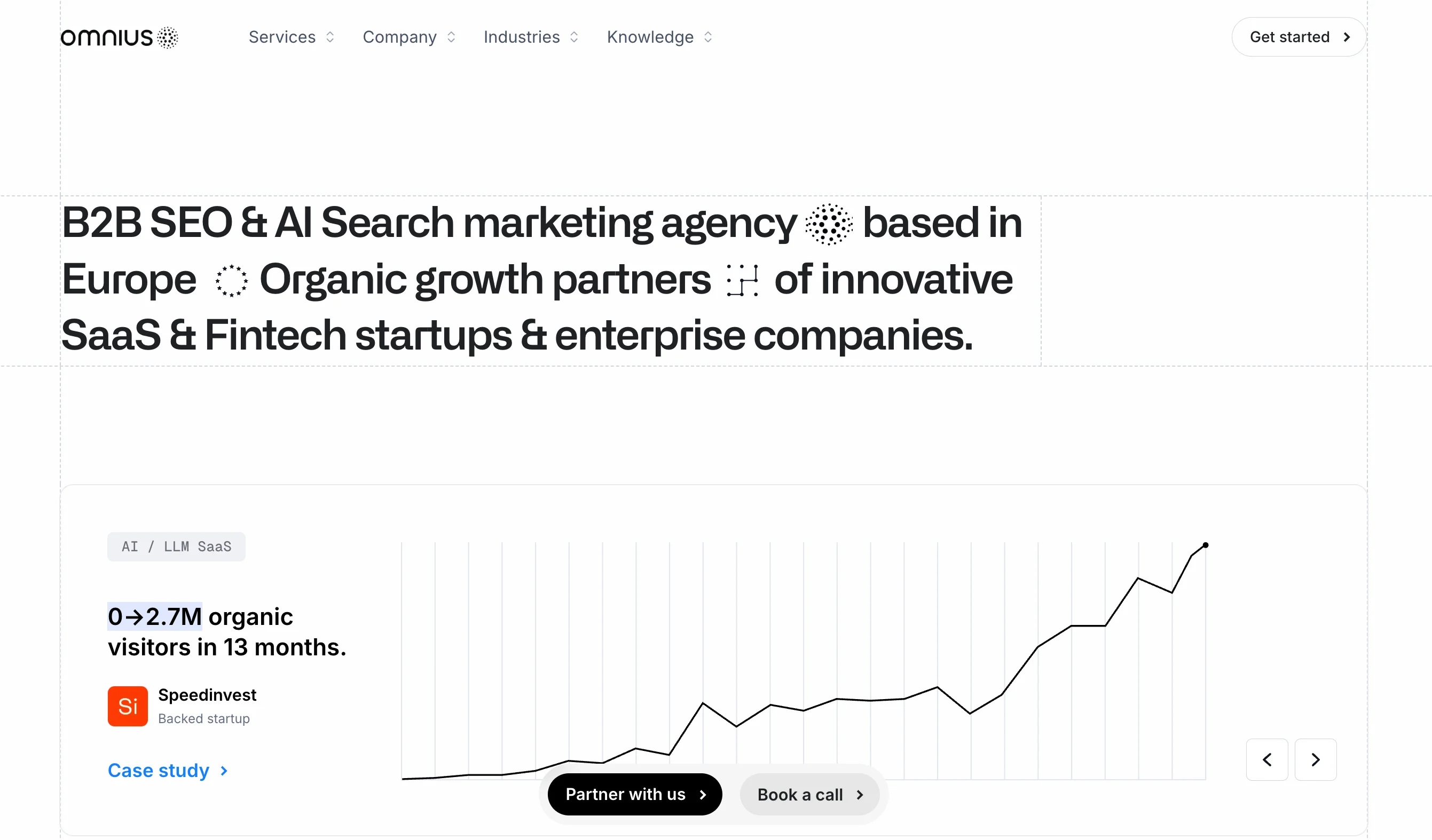
Compared to the other agencies on this list, OMNIUS leads on B2B SaaS SEO with an early move into Generative Engine Optimization (GEO). They structure content for both Google rankings and AI citations (ChatGPT, Perplexity, Google AI Overviews), which makes them one of the few German agencies preparing clients for how B2B buyers actually search in 2026.
Key services:
- Technical SEO audits and implementation
- B2B SaaS content strategy and production
- Generative Engine Optimization (GEO)
- Answer Engine Optimization (AEO)
- AI visibility audits
Best for:
- B2B SaaS where organic search is a strategic growth lever
- AI startups, devtools, and analytics SaaS where ChatGPT recommendations shape buying decisions
- SaaS companies playing the long game on owned distribution
Location: Berlin, Germany (serves clients globally)
Pricing: Contact for pricing
Pros:
- One of the first European agencies to operationalize GEO and AEO
- Strong technical SEO foundation, not just content production
- Compounding results that outlast individual campaigns
- Track record across SaaS, fintech, and AI clients
Cons:
- SEO and GEO take time. Expect 3 to 6 months before traffic moves and 6 to 12 months before pipeline impact shows up
- If your board needs results in 60 days, this is the wrong agency
Inno One
Compared to the other agencies on this list, Inno One is built entirely around LinkedIn. They combine paid LinkedIn ads, founder ghostwriting, and organic content to generate B2B pipeline, which makes them the strongest pick when LinkedIn is the buyer's primary channel.
Key services:
- LinkedIn Ads management
- Founder LinkedIn ghostwriting and content strategy
- Organic LinkedIn distribution
- B2B demand generation
- LinkedIn ABM campaigns
Best for:
- B2B SaaS where the ICP includes CMOs, VPs of Sales, RevOps leaders, or engineering decision-makers
- Founders willing to post on LinkedIn 2 to 4 times per week
- SaaS teams treating LinkedIn as a primary growth channel rather than an awareness afterthought
Location: Berlin, Germany (also serves DACH and international clients)
Pricing: Contact for pricing
Pros:
- Deep specialization on a single channel that matters for most B2B SaaS in 2026
- Founder branding integrated with paid amplification, not treated separately
- Strong understanding of DACH-specific LinkedIn behaviour and creative norms
- Pipeline-focused reporting
Cons:
- LinkedIn-only focus means they are not the right pick if your ICP lives elsewhere (developer communities, regulated industries with low LinkedIn activity)
- Underperforms when founders are not willing to publish consistently
Suxeedo (Cologne)
Compared to the other agencies on this list, Suxeedo specializes in long-form content marketing for German B2B technology companies. They produce SEO content and PR work that the German technology trade press will actually pick up, which is a different skill from English-language content production.
Key services:
- Content strategy and editorial planning
- SEO content production (German and English)
- Technology PR and media relations
- Content distribution
- Brand storytelling
Best for:
- B2B SaaS investing in long-form content as a category-creation play
- Companies whose buyers read Heise, t3n, Computerwoche, or German-language industry publications
- Mid-market and enterprise SaaS with longer sales cycles
Location: Cologne, Germany (serves DACH region)
Pricing: Contact for pricing
Pros:
- Strong editorial fluency in German-language B2B content
- Genuine relationships with German technology trade press
- Proven SEO content production at scale
- Useful for international SaaS that wants German content done locally
Cons:
- Content-heavy specialization means less depth in paid acquisition or marketing operations
- Best fit when your buyers actually read German trade publications. Less useful for English-first global SaaS
Saupe Communication (Stuttgart)
Saupe Communication SaaS marketing agency hero showing a rhinoceros walking through a supermarket aisle with the headline "We make your B2B product noticeable. In your exact market."
Compared to the other agencies on this list, Saupe Communication handles enterprise B2B with complex, multi-stakeholder sales cycles. They are the pick for selling to procurement-led buyers in industrial software, manufacturing tech, and the German Mittelstand, where Berlin agencies usually lack the right context.
Key services:
- B2B branding and positioning for complex products
- Growth marketing for enterprise SaaS
- Sales enablement collateral
- Long-form case study production
- Lead generation for multi-stakeholder deals
Best for:
- Enterprise SaaS with 9-month-plus sales cycles
- Industrial software and manufacturing tech selling into Mittelstand
- SaaS selling to procurement, IT, and compliance buyers in the same deal
Location: Stuttgart, Germany (serves DACH and international Mittelstand)
Pricing: Contact for pricing
Pros:
- Genuine Mittelstand fluency that Berlin and Munich agencies usually lack
- Comfortable with multi-stakeholder buying committees
- Strong case study production capability
- Sales enablement built in, not bolted on
Cons:
- Less startup-friendly. If you are pre-Series A or moving fast, the pace and processes may feel heavy
- Higher retainers than channel-specific specialists
Growably (Berlin)
Compared to the other agencies on this list, Growably focuses on Webflow sites and conversion rate optimization for early-stage SaaS. Their angle: if your site is the bottleneck (and for most early-stage SaaS, it is), fixing it produces more pipeline per euro than any new ad channel.
Key services:
- Webflow site builds and migrations
- Conversion rate optimization (CRO)
- Messaging strategy and copywriting
- Landing page experimentation
- A/B testing infrastructure
Best for:
- Pre-seed to Series A SaaS with product-market fit but a converting bottleneck on the site
- SaaS companies running paid acquisition with a site that under-converts traffic
- Founders who want messaging clarity before scaling spend
Location: Berlin, Germany (serves clients globally)
Pricing: Contact for pricing
Pros:
- Right-sized for early-stage SaaS budgets
- Clear focus on site conversion as the primary growth lever
- Webflow expertise paired with messaging and CRO under one team
- Honest about scope. They will turn down clients whose problem is not the website
Cons:
- Site-focused specialization means they are not the right pick if your problem is traffic generation
- One-time project model means less ongoing partnership unless you continue on a CRO retainer
Arvana (Berlin)
Compared to the other agencies on this list, Arvana runs outbound and B2B lead generation as one combined motion (cold email, LinkedIn outreach, paid social). They fill demo calendars for SaaS that are past the messaging stage and have a sales team ready to close.
Key services:
- Cold outbound (email and LinkedIn)
- Demo booking and pipeline generation
- Paid social for B2B
- Account-based marketing for mid-market
- Lead qualification
Best for:
- B2B SaaS past Seed stage with a working sales team
- Companies needing 5 to 15 qualified demos per week
- SaaS with a defined ICP and a closing process
Location: Berlin, Germany (serves DACH and international SaaS)
Pricing: Contact for pricing
Pros:
- Opinionated about what "qualified" means. Will refuse to book meetings that miss their bar
- Combined outbound, LinkedIn, and paid social under one team
- Strong fit for SaaS where founder-led sales is transitioning to a sales team
Cons:
- Outbound only works when product, message, and sales process are already strong. They will tell you that, but pre-product-market-fit teams should fix those first
- Less useful for SaaS where the buyer rejects cold outreach (some developer audiences, regulated industries)
Jolly Marketer (Berlin)
Compared to the other agencies on this list, Jolly Marketer specializes in AI-driven cold outreach plugged directly into HubSpot. They use Clay, Apollo, and Lemlist at the operational layer with HubSpot as the system of record, which makes them fast to plug in for HubSpot-native SaaS.
Key services:
- AI-personalized cold email
- LinkedIn outbound automation
- HubSpot ABM workflows
- Signal-based outbound (funding alerts, hiring signals, tech stack changes)
- Outbound infrastructure setup
Best for:
- HubSpot-native B2B SaaS at Series A and above
- SaaS with a defined ICP and clean intent data
- Teams wanting outbound without building it in-house
Location: Berlin, Germany (serves DACH and English-speaking clients)
Pricing: Contact for pricing
Pros:
- Deep HubSpot integration that most outbound agencies treat as an afterthought
- AI personalization grounded in clean intent data, not generic templates
- Honest about disqualification criteria and signal quality
- Fast onboarding for HubSpot-native teams
Cons:
- Less useful if your CRM is Salesforce, Pipedrive, or custom
- AI personalization quality depends on the underlying signal. Garbage in, garbage out still applies
Fox Agency (London with DACH presence)
Compared to the other agencies on this list, Fox Agency is a London-headquartered B2B technology agency with real DACH coverage. They handle integrated programs across Germany, the UK, and the Nordics, which makes them a fit for SaaS marketing across multiple European markets under one partner.
Key services:
- B2B branding and positioning
- Paid media across European markets
- Content marketing and demand generation
- Integrated campaign management
- ABM for enterprise SaaS
Best for:
- Growth-stage SaaS marketing across multiple European countries
- Companies wanting brand consistency without three regional agency partners
- B2B technology brands targeting both UK and DACH
Location: London, UK with DACH and Nordics coverage
Pricing: Contact for pricing
Pros:
- Multi-market European coverage under one team
- Strong brand and integrated campaign capability
- Enterprise-grade processes for larger SaaS
- Proven case studies with European B2B technology brands
Cons:
- DACH presence is smaller than UK operations. Verify how many team members on your account are Germany-based or German-native
- Higher minimum retainers than DACH-only specialists
SaaStorm (Berlin)
Compared to the other agencies on this list, SaaStorm focuses on SaaS marketing operations and lifecycle, which is the part of growth marketing that does not fit cleanly into "paid" or "content" buckets. They are the pick when your bottleneck is operational capacity rather than strategy or channel execution.
Key services:
- SaaS marketing operations
- Lifecycle and email programs
- HubSpot or Salesforce administration
- Marketing automation
- Pipeline reporting and attribution
Best for:
- B2B SaaS at Series A and above where the in-house marketing team is one or two people
- Companies where pipeline reporting cannot answer "which campaigns produced revenue last quarter"
- SaaS teams that need someone to own the operational layer
Location: Berlin, Germany (serves international SaaS)
Pricing: Contact for pricing
Pros:
- Owns the unglamorous, high-leverage operational layer most agencies skip
- Fixes attribution and reporting before running new campaigns
- HubSpot and Salesforce fluency
- Frees the in-house team to focus on strategy and content
Cons:
- Not a creative or strategy-led agency. If you need brand and messaging work, pair with another partner
- Less useful if your operational stack is already strong
Native Digital
Compared to the other agencies on this list, Native Digital is the paid acquisition specialist for B2B SaaS in Germany. They focus on performance across Google Ads, LinkedIn Ads, Meta retargeting, and conversion optimization, with the diagnostic discipline to distinguish a paid acquisition problem from a conversion problem.
Key services:
- Paid media management (Google, LinkedIn, Meta)
- Performance marketing strategy
- Conversion optimization
- Paid attribution setup
- Creative testing infrastructure
Best for:
- B2B SaaS with a working ICP, converting product, and need to scale paid acquisition
- Seed-plus and Series A SaaS where paid spend is the primary lever
- Companies that want a paid-only specialist rather than a generalist
Location: Berlin and remote (serves DACH and English-speaking SaaS)
Pricing: Contact for pricing
Pros:
- Diagnostic discipline. Asks to see CAC payback math before signing
- Cross-channel paid expertise (not LinkedIn-only or Google-only)
- Conversion optimization built into the retainer, not sold separately
- Revenue-focused reporting
Cons:
- Paid-only focus means SEO, content, and brand work need a separate partner
- Less useful for pre-revenue SaaS still figuring out ICP and messaging
Best B2B SaaS marketing agencies in Germany by specialty
Different agencies solve different problems. Match the specialty to your single biggest growth bottleneck.
What B2B SaaS marketing in Germany actually looks like
B2B SaaS marketing in Germany is the practice of acquiring and retaining business customers for software products in the DACH region. It differs from US-style SaaS marketing in three ways: longer sales cycles, stricter GDPR data limits, and a stronger preference for proof-heavy content over hype-driven campaigns.
Here's the part most US-trained marketers underestimate. German B2B buyers read more before they buy. They forward your white paper to two colleagues before they book a demo. They expect a written quote, not a "let's hop on a call." They also expect a vendor to know what the GVO, the EU AI Act, and Schrems II actually mean for their data stack.
Most US playbooks miss this. They optimize for speed of conversion when the German buyer optimizes for confidence of conversion. Those are not the same thing.
The right agency in Germany understands these differences instinctively. They write German-language assets (or commission them), build attribution that survives a consent rejection, and write case studies that are specific enough to be useful, not just decorative.
Paid ads as a B2B SaaS growth strategy in Germany
Most B2B SaaS marketers in Germany are underspending on paid ads, overspending on the wrong channels, or both. The reason is rarely budget. It is usually attribution.
When GDPR-consent reduces tracked conversions by half (and it often does), the paid ads dashboard looks worse than the actual business outcome. Founders see the gap, blame the channel, and pull spend. Six weeks later, pipeline drops and they cannot trace why. That sequence repeats more often in DACH than in any other region we work in.
Here's how to think about it instead.
{{ad-library}}
Why most B2B SaaS paid ads in Germany fail
Three failure modes, in order of how often we see them:
- The creative is English-only: A LinkedIn ad written in English performs 30 to 50 percent worse in Germany than the same idea in German. Most US-trained marketers do not localize because the buyer speaks English. The buyer ignoring an English ad in their German LinkedIn feed is not the same as the buyer not speaking English
- The targeting is too broad: "B2B decision-makers in DACH" is not an audience. It is a thought. Working audiences are usually 5,000 to 50,000 people, defined by job title, company size, and a third filter (technology stack, recent funding event, hiring signal)
- There is no offline conversion pipeline: Most B2B SaaS sales happen days or weeks after the ad click, often in a different browser. Without offline conversion tracking back to LinkedIn or Google, the algorithm optimizes for the wrong signal
Fix those three, and most paid ads programs in Germany double their reported pipeline within a quarter. Without metrics changing. Just measurement changing.
LinkedIn Ads in Germany
LinkedIn is the default paid channel for most B2B SaaS in Germany. Click costs are high (€8 to €25 per click is normal for senior audiences), but the targeting precision compensates when the ICP is sharp.
What works in DACH on LinkedIn:
- Thought leader ads (sponsoring a founder or executive's organic post) outperform brand-page promoted content by a wide margin
- Document ads for gated white papers and reports drive cost-per-lead 30 to 50 percent below conversation ads in most accounts
- Bottom-of-funnel retargeting with case study video or product demo content produces 2 to 4 times the booked meetings per euro vs cold prospecting
What rarely works:
- Lookalike audiences in DACH (the LinkedIn dataset is shallower than in the US)
- Video ads over 30 seconds without subtitles
- US-style "book a 15-minute call" CTAs to cold audiences
Google Ads for B2B SaaS
Google Ads is the bottom-of-funnel channel. The buyer who searches "best CRM for German SaaS startup" already has intent. Most B2B SaaS underspend on this exact moment.
Three Google Ads plays that produce pipeline in DACH:
- Branded keywords including competitor brand defence (cheap, defensive, often ignored)
- Commercial-intent keywords ("best [category] software," "[category] software pricing," "alternative to [competitor]")
- Search retargeting combined with LinkedIn retargeting for buyers who searched once and then went silent
Meta and Reddit retargeting for the dark funnel
The dark funnel is where most B2B SaaS buyers live. They listen to podcasts, lurk on Reddit, scroll LinkedIn without engaging, and read newsletters. None of this shows up in attribution.
Meta and Reddit retargeting catches these buyers at moments your CRM cannot see. Cheap CPMs, low expectations on direct attribution, but real lift in branded search and direct traffic over 90-day periods. Run them as awareness layers, not pipeline channels.
G2 and Capterra placements
For B2B SaaS where the buyer compares 3 to 5 vendors on a review site before buying, G2 and Capterra ads convert at rates that most paid channels cannot reach. The intent is highest in the funnel. The cost is real (€2,000 to €15,000 per month is typical), but for the right category, the math works fast.
If your category has fewer than 10 listed competitors on G2, the placement is probably underpriced. If it has 50-plus, the placement is usually overpriced.
The role of ad creative
This is where most B2B SaaS programs leave money on the table. The targeting is fine. The bidding is fine. The creative is generic.
In a DACH paid program, the creative is the highest-leverage variable you can change. Refreshing creative every 2 to 4 weeks (with at least 6 variants live at any time) produces compounding lift. Running the same three ads for 6 months produces audience fatigue, frequency cap problems, and the kind of slow performance decline that founders blame on "the channel."
This is one reason magier exists as a specialist on this list. Most agencies bundle creative into the retainer and produce one or two ads per quarter. That cadence is not enough.
What CAC payback looks like for paid ads in DACH
Realistic benchmarks for B2B SaaS paid ads in Germany, based on agency work we have visibility into:
- LinkedIn Ads: CAC payback of 14 to 24 months is typical at €5K to €15K monthly spend
- Google Ads: CAC payback of 6 to 14 months on commercial-intent keywords; longer on broader terms
- G2 and Capterra: CAC payback of 8 to 18 months, with higher LTV because review-site buyers are further down the funnel
- Meta and Reddit retargeting: Not directly attributable. Measure as a lift on branded search and direct over 90-day windows
If an agency promises sub-6-month CAC payback on LinkedIn Ads to cold audiences, ask for the case study. Then ask for the next two. The first one is sometimes a one-off.
How to choose a B2B SaaS marketing agency in Germany
The decision matters more than the shortlist. Use this framework.
Match the agency's primary specialty to your biggest growth problem
Generalists sound flexible. They are usually mediocre at everything and excellent at nothing. If your bottleneck is paid acquisition, hire a paid acquisition specialist. If it is SEO, hire an SEO specialist. If your site converts at 0.5 percent, hire a CRO and Webflow specialist before you spend another euro on traffic.
Verify B2B SaaS specialization, not just B2B
B2B is a category. B2B SaaS is a discipline. The agency that sells to industrial manufacturers understands one buying motion. The agency that sells to mid-market software companies understands a different one. Ask what percentage of their clients are B2B SaaS specifically. If it is below 60 percent, weigh that.
Demand revenue-focused case studies
Traffic is not revenue. Impressions are not revenue. Even MQLs are not revenue. Ask for case studies that include ARR, pipeline value, or CAC payback. If they cannot share those, they probably do not measure their work that way.
Confirm who actually works on your account
The senior strategist who runs the sales call is often not the person doing your work. Ask, in writing, who your day-to-day contact will be, what their tenure is, and how many accounts they manage. Above 8 accounts per manager is a flag.
Insist on flat-fee or hybrid pricing
Percentage-of-spend pricing rewards bigger ad budgets, not better outcomes. The agency earns more when you spend more, regardless of whether spending more was the right call. Flat-fee retainers align incentives around efficiency. Hybrid models (base retainer plus performance bonus) work when the performance bonus is tied to revenue, not impressions.
Test their understanding of GDPR and DACH-specific constraints
Ask: "How do you handle attribution when consent is rejected?" The right answer involves server-side tracking, offline conversion API, and a CRM-first attribution model. The wrong answer involves "we'll figure it out" or "most tools handle that automatically." They do not.
Ask about CRM integration
If reporting stops at the ad platform dashboard, the agency cannot prove pipeline impact. Real attribution requires HubSpot or Salesforce integration. Confirm this in writing during onboarding.
Evaluate contract length and exit clauses
Month-to-month with a 30-day exit is the new standard for confident agencies. A 12-month minimum with no performance clause is a protection mechanism for the agency, not the client. Negotiate it down or walk away.
How much do B2B SaaS marketing agencies in Germany cost?
B2B SaaS marketing agencies in Germany typically charge €3,000 to €18,000 per month. Early-stage SaaS at €1M to €5M ARR usually pays €3,000 to €6,000 monthly. Growth-stage SaaS at €5M to €20M ARR typically pays €6,000 to €12,000. Enterprise SaaS pays €12,000 and up.
A few notes on pricing models, in plain language:
- Flat-fee retainer. Preferred. The agency earns the same whether your budget is €30K or €60K per month. Their only path to justify the fee is to make your existing budget work harder
- Percentage of spend. Avoid. The agency earns more when you spend more. Your CAC can rise while their revenue from you doubles
- Performance-based. Works when the metric is revenue or pipeline. Risky when the metric is leads, because lead quality varies wildly
- Hybrid (base plus bonus). Good balance, provided the bonus is tied to a real revenue metric
Red flags when hiring a B2B SaaS marketing agency in Germany
Avoid agencies that show any of these signs during evaluation.
- Percentage-of-spend pricing: Their revenue grows when your CAC grows. The incentives are misaligned by design
- Twelve-month minimum with no performance clause: They are protecting themselves, not committing to your outcome
- Vanity metrics in case studies: "Traffic grew 300 percent" means nothing if pipeline stayed flat. Look for ARR, SQO, or CAC payback
- Bait-and-switch staffing: Senior strategists during sales, junior account managers after signing. Confirm in writing who does the actual work
- No SaaS-specific case studies: They will learn on your budget. Require proof of relevant work
- Promises of results in 30 days: Paid media needs 4 to 8 weeks. SEO needs 3 to 6 months minimum. Anyone faster is either lucky or lying
- No CRM integration: Without HubSpot or Salesforce integration, attribution stops at the platform dashboard and pipeline claims are unverifiable
- No German-language capability: If your buyers read German content, an English-only agency limits half your TAM
- The same playbook for every client: "We do this for everyone" means strategy is missing. Your business needs adaptation, not template
- They cannot describe your ICP back to you: If the agency starts campaigns without a clear ICP brief, they are guessing with your money
Agency vs in-house: which one fits your German SaaS team?
The decision depends on stage, budget, and the kind of marketing work you need done.
Most German B2B SaaS teams at Series A and below use agencies. The fully in-house model usually becomes economical only at €20M+ ARR, or when the founder is convinced that marketing is the long-term strategic moat and wants brand knowledge living inside the company.
The hybrid model is common at Series A to B. In-house owns brand, content strategy, and product marketing. Agencies own paid media, SEO execution, and CRO. We see this setup in roughly half of the funded SaaS teams we speak to in Berlin.
B2B SaaS marketing trends shaping 2026 in Germany
A few shifts that matter for the agency choice.
AI search is real, and German buyers use it
ChatGPT, Perplexity, and Google's AI Overviews are now part of the B2B buyer journey, including in DACH. Agencies that optimize for Generative Engine Optimization and Answer Engine Optimization are pulling ahead of those that only optimize for traditional SEO.
Capital efficiency replaced growth-at-all-costs
German VCs were always more conservative than US VCs on this. Now the US is catching up. The result: agencies that prove CAC payback and LTV-to-CAC ratios are easier to defend to a board than agencies that report on traffic and impressions.
The dark funnel is wider in DACH than in the US
German B2B buyers do more research in untracked channels (podcasts, communities, peer conversations) before they ever fill a form. Attribution stacks that only measure trackable touches systematically undercount marketing's contribution.
Founder-led distribution beats SEO for the first 18 months
For early-stage German SaaS, a founder who posts on LinkedIn 3 times per week, with the agency ghostwriting and amplifying, often outperforms a 6-figure SEO investment. This holds until the brand has enough trust that organic search converts at acceptable rates.
The EU AI Act adds a layer to martech procurement
Enterprise buyers in DACH are starting to ask about AI usage in marketing tools (HubSpot, Clay, etc). Agencies that can answer these questions for you reduce sales friction.
A closing note
The right B2B SaaS marketing agency can compound your growth in ways an in-house team rarely matches at the same stage. The wrong one burns budget while showing dashboards full of green metrics that never reach revenue.
If you take one thing from this guide, let it be this. Match the agency's primary specialty to your single biggest growth problem. Then verify their B2B SaaS depth, their revenue-focused case studies, and their pricing model. Most other variables follow from those three.
If the gap in your stack is ad creative or Webflow design rather than full-funnel growth, magier handles that one layer with a B2B SaaS focus most generalist design agencies miss.
{{redirect}}
Frequently asked questions
What is a B2B SaaS marketing agency?
A B2B SaaS marketing agency is a specialist firm that helps software-as-a-service companies acquire and retain business customers. The work usually includes demand generation, SEO, paid media, content marketing, and marketing operations, with frameworks built specifically for recurring revenue models and long sales cycles.
How much do B2B SaaS marketing agencies in Germany cost?
B2B SaaS marketing agencies in Germany typically charge between €3,000 and €18,000 per month. Pre-seed and seed-stage SaaS usually pays €1,500 to €3,500. Early growth-stage pays €3,000 to €6,000. Enterprise SaaS pays €12,000 and up. Flat-fee retainers are the most common structure.
What is the best B2B SaaS marketing agency in Germany?
The best agency depends on the growth problem you are solving. For DACH market entry, GROWSaaS. For B2B SEO and GEO, OMNIUS. For LinkedIn-led demand generation, Inno One. For ad creative and Webflow, magier. For paid acquisition specifically, Native Digital. There is no single best agency, only the best match.
How do I choose a B2B SaaS marketing agency in Germany?
Start by identifying your single biggest growth problem. Match an agency that specializes in that area. Verify B2B SaaS specialization (above 60 percent of their client base), demand revenue-focused case studies, confirm who will do the actual work, and insist on flat-fee or hybrid pricing. Ask about GDPR-compliant attribution explicitly.
Do German B2B SaaS agencies work with international companies?
Yes. Most of the agencies on this list work with international SaaS expanding into the DACH region. GROWSaaS and Fox Agency, in particular, have built their models around international SaaS market entry. Confirm German-language capability in the team that will work on your account, especially if your buyers read German content.
How long until I see results from a B2B SaaS marketing agency?
Paid media usually shows initial signal in 2 to 4 weeks and meaningful ROI in 2 to 3 months. SEO takes 3 to 6 months for traction and 6 to 12 months for measurable impact. Outbound and ABM typically show pipeline impact in 1 to 3 months. The first 30 to 60 days should be foundation work, not campaign results.
Is B2B SaaS marketing different in Germany than in the US?
Yes. Sales cycles are longer (90 to 180 days vs 30 to 90 in the US). Buying committees are larger (5 to 9 stakeholders vs 3 to 6). GDPR limits attribution. LinkedIn CPMs are 2 to 4 times higher. German buyers prefer proof-heavy content over hype. Most agencies that copy US playbooks underperform in DACH.
How do GDPR rules affect B2B SaaS marketing in Germany?
GDPR consent rates in Germany run roughly 30 to 50 percent, which means most of the tracked conversion data US-style agencies rely on is missing. Effective agencies build server-side tracking, offline conversion APIs, and CRM-first attribution to reconstruct what GDPR-blocked cookies cannot. Without this, paid ads optimization runs on incomplete signal.
.png)