Did you know that, according to research from the LinkedIn B2B Institute and the Ehrenberg-Bass Institute, 95% of B2B buyers are not in the market at any given time. For your business, this means that most of your outbound budget is being spent trying to pursue people who are actively ignoring you.
B2B inbound marketing takes the opposite approach. Instead of buying attention, you earn it by creating content, tools, and experiences that your buyers actually want to find. Think blog posts that rank on Google, free tools that solve a real problem, webinars that teach instead of pitch, or case studies that show up exactly when a prospect is evaluating solutions. These are some classic B2B inbound marketing examples.
It's not just a better experience for buyers, it's also more efficient for business growth. According to Growleads' 2025 B2B comparison, inbound marketing costs $75 to $150 per lead versus $200 to $500 for outbound, and converts at nearly double the rate.
We collected 12 real-world inbound marketing examples of B2B companies that figured this out and incorporated inbound into their growth engine. This article walks through each one, organized by channel, with the sourced results they achieved.
Here is what you will learn:
- How companies like HubSpot, Slack, Gong, and Drift turned inbound into their primary growth engine.
- Which B2B inbound marketing channels actually produce measurable pipeline, based on data from Semrush, the Content Marketing Institute, and the Demand Gen Report.
- Where paid advertising fits into an inbound strategy (and why most guides ignore it).
- How to measure inbound marketing ROI using the right metrics and tools.
All 12 B2B inbound marketing examples at a glance
{{redirect}}
What is B2B inbound marketing?
B2B inbound marketing is the marketing method of attracting business buyers through valuable content, search engine optimization, and educational resources rather than through cold outreach or interruptive advertising. The idea is that when you help buyers solve problems before they are ready to buy, they remember you when the budget shows up.
HubSpot's co-founders Brian Halligan and Dharmesh Shah brought the concept under limelight when they described inbound marketing as creating valuable experiences that have a positive impact on both people and your business. The practice has since become a standard B2B marketing strategy for companies across SaaS, professional services, manufacturing, and more.
What makes inbound marketing different from demand generation or content marketing, you may ask? In short, content marketing is a tactic within inbound (we’ll cover it below). Demand generation can include both inbound and outbound methods. Inbound marketing is simply the broader philosophy of earning attention rather than purchasing it.
Inbound vs. outbound marketing: how they compare
Before we get into specific inbound marketing examples, it helps to understand where inbound stands compared to outbound. You need to remember that the two are not mutually exclusive. In fact, many of the best B2B marketing strategies combine both. But the economics and buyer preferences are moving strongly in one direction.
Consider this from the 2023 6sense Report: buyers are already 70% through their journey before they ever contact sales, and 84% of the time, they've already picked their vendor.
But here's the real question: does that mean outbound is dead? No. It means outbound works best when it is built on a foundation of inbound trust. A cold email from a company whose blog you have already read will feel more relevant that the one you have never heard of. That is why the most effective B2B inbound marketing strategy is usually a hybrid of both inbound and outbound: outbound distribution brings the right audience to inbound content.
Need some extra help with your marketing? Check out this roundup on the best B2B SaaS marketing agencies and pick the right one for your needs.
The 12 Best B2B inbound marketing examples
1. Educational content hubs and SEO (HubSpot)
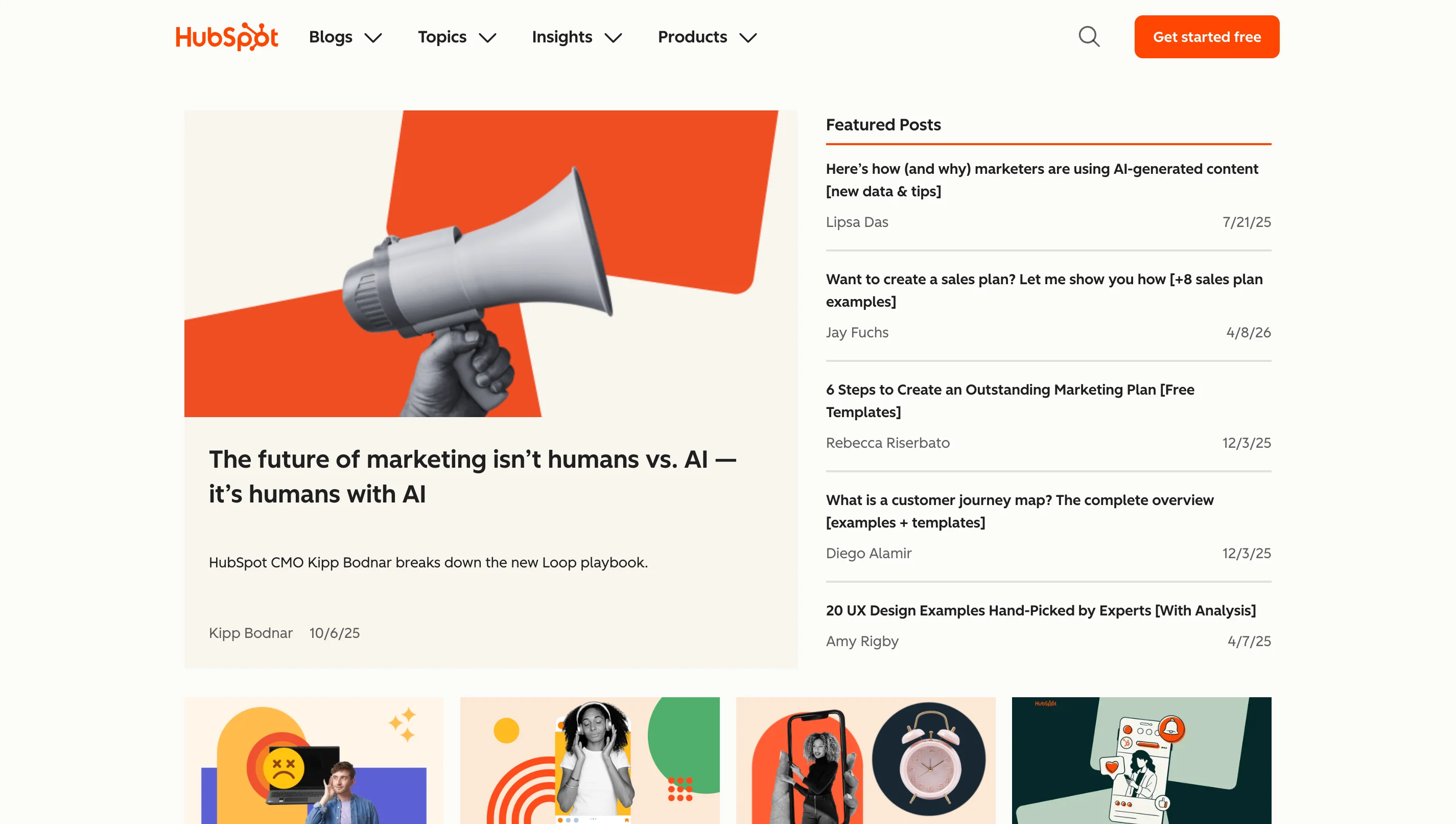
HubSpot is the most referenced B2B inbound marketing example for good reason. The company built its entire growth engine around free, educational content, and it did so before most B2B companies had a blog.
Case study example: HubSpot created a massive content library covering every topic a marketer, salesperson, or customer service professional might search for. This includes their blog (which publishes multiple posts per day), HubSpot Academy (free certification courses), and an extensive template library. They organized all of this around the topic cluster model, where a central pillar page covers a broad subject and linked spoke articles address specific subtopics.
The results: According to Semrush and SimilarWeb traffic estimates, the HubSpot blog attracts over 7 million monthly visits. HubSpot Academy has certified more than 300,000 professionals, according to HubSpot's own reporting. The blog and academy function as the company's top-of-funnel engine, generating a massive volume of marketing qualified leads (MQLs) that feed into their CRM and sales pipeline.
Why it works as a B2B SEO strategy: HubSpot does not write content about HubSpot. They write content about the problems their buyers face: how to write a business plan, how to create an email template, how to build a marketing strategy. By solving those problems through long-form educational content, they rank for thousands of high-intent keywords. When those readers eventually need marketing software, HubSpot is the first name that comes to mind. Brian Dean at Backlinko has documented extensively how this kind of search-focused content strategy builds compounding organic traffic when each piece targets a specific buyer persona and search intent.
Marcus Sheridan, author of They Ask, You Answer (commonly called the TAYA framework), built his entire methodology around a similar principle. The core idea: answer every question your buyer has, honestly and thoroughly, before they even talk to sales. Companies that adopt this approach tend to shorten their sales cycles because the buyer arrives already informed and already trusting.
This is B2B content marketing at its most disciplined. It is not about publishing volume. It is about matching your content to the exact questions buyers are typing into Google, Perplexity, and ChatGPT. With answer engine optimization (AEO) becoming more relevant in 2026, the companies that structure their content for both traditional SERP ranking and AI-driven citation will have a significant advantage.
2. Paid advertising for inbound content distribution (Drift, HubSpot)

Most guides on B2B inbound marketing skip paid advertising entirely, treating it as a purely outbound tactic. That is a mistake. Paid ads become an inbound channel when you use them to distribute valuable content to a targeted audience instead of pushing a cold sales pitch.
Case study example: Drift and HubSpot both run paid campaigns on LinkedIn Ads and Google Ads, but the content they promote is educational, not transactional. Drift used LinkedIn Sponsored Content to promote ebooks, webinars, and blog posts rather than product demo requests. HubSpot runs campaigns targeting high-intent B2B keywords, directing traffic to free tools and comprehensive guides rather than hard sell landing pages. Both companies also invest heavily in retargeting campaigns, which re-engage people who have already visited their blog or downloaded a resource.
The results: Research from the LinkedIn B2B Institute and the IPA Databank shows that emotional B2B ads are 7x more effective at driving long-term business outcomes compared to rational, feature-focused messaging. This is partly because of the 95/5 rule: at any given time, 95% of your target market is not actively buying (LinkedIn B2B Institute, John Dawes, Ehrenberg-Bass Institute). Paid content distribution keeps your brand visible during that long "not ready yet" window, so when the buyer eventually enters the market, you are already familiar.
Why it works as B2B demand generation: There is a meaningful difference between running a LinkedIn ad that says "Book a demo" and running one that says "Download our 2026 B2B marketing playbook." The first one targets the 5% who are in-market today. The second one builds a relationship with the 95% who are not. Both Drift and HubSpot have proven that paid distribution of inbound content reduces customer acquisition cost (CAC) over time because it generates warmer leads who already trust the brand.
This approach also complements well with account-based marketing (ABM). You can use Clearbit or LinkedIn's targeting tools to serve your best inbound content specifically to accounts on your target list. The content does the educating. The targeting makes sure it reaches the right people. That is paid media used as an inbound strategy, and it is one of the most underused B2B inbound marketing examples in practice.
3. Product-led growth and freemium (Slack)

Slack did not grow to 8 million daily active users in four years by running outbound sales campaigns. According to Slack's S-1 filing with the SEC in 2019, the company grew almost entirely through product-led growth (PLG), where the product itself functions as the primary marketing and sales tool.
Case study example: Slack offered a free tier that gave teams full access to the core product. No credit card required. No time limit. Teams could adopt Slack organically, experience its value, and then upgrade when they hit usage limits or needed enterprise features. The product's community-driven design meant that every new user who invited their team was effectively running a referral campaign without realizing it.
The results: Slack went from zero to 8 million daily active users in four years, with a reported 30% conversion rate from free to paid plans, according to multiple independent analyses of their S-1 data. Their SaaS marketing strategy centered entirely on making the product so useful that sales conversations became unnecessary for most of the buyer journey.
Why it works as B2B inbound marketing: Product-led growth is inbound in its purest form. Instead of writing a blog post about why your product is great, you let people experience it. The free tier functions like a content library: it educates the buyer on the product's value through direct use rather than through content alone.
This model has since been adopted by companies like Notion, Canva, Zapier, Shopify, Intercom, and Ahrefs (more on Ahrefs later). The common thread is a freemium product that removes friction from the buyer journey. The product is the content. The user is the distribution channel.
Here is the caveat: product-led growth requires a product that delivers value immediately. If your product needs a 45-minute onboarding call to make sense, freemium will not work. But if you can give users a meaningful experience within minutes, PLG can reduce your customer acquisition cost more than any other inbound channel.
4. Thought leadership on LinkedIn (AirOps / Alex Halliday)

B2B buyers trust people more than they trust brand pages. That insight drove one of the most effective B2B social media marketing strategies of the past five years: founder-led and executive-led thought leadership on LinkedIn.
Case study example: Alex Halliday, founder and CEO of AirOps, built the company's brand in large part through consistent, personal content on LinkedIn. He posts regularly about AI-powered content strategy, organic growth, and the realities of building a startup for the fourth time. His content is specific, opinionated, and grounded in the company's actual work, which makes it stand out in a feed full of corporate announcements. AirOps' Head of Marketing Josh Spilker mirrors this approach, posting about content engineering, SEO tools, and practical AI workflows. The company's broader team follows the same philosophy: share your own perspective rather than just reshare the brand page.
The results: According to the Content Marketing Institute's annual B2B research, 38% of B2B marketers use LinkedIn as a primary channel for lead generation. For AirOps specifically, the founder-led content strategy has helped the company build a highly engaged audience of CMOs, growth leaders, and content strategists on LinkedIn. That audience showed up when AirOps raised a $40M Series B led by Greylock, and again when they launched their first conference, AirOps Next, in New York City. The company has also partnered with Kevin Indig to co-publish the largest ChatGPT citation study to date (16,851 queries, 353,799 pages analyzed), which earned citations from Search Engine Land, Search Engine Journal, and SparkToro. That research credibility started on LinkedIn.
Why it works as a B2B inbound marketing strategy: When a founder shares a strong opinion about their industry on LinkedIn, the engagement rate is typically 5 to 10x higher than the same message posted from a company page. That is because LinkedIn's algorithm favors personal content, and because B2B buyers are more likely to engage with a human voice than a corporate one.
Chris Walker, founder of Refine Labs, made a similar observation about what he calls "dark social." A large share of B2B buying decisions are influenced by content seen on LinkedIn, podcasts, and community forums that traditional attribution models do not capture. The buyer fills out a demo form and says they "found you on Google," but the reality is they first saw your CEO's LinkedIn post six months ago. Dave Gerhardt proved this at Drift, where his personal LinkedIn audience became inseparable from the company's brand, and later used that same audience to launch Exit Five, a B2B marketing community.
Sky Yang made a point on LinkedIn that resonated with a lot of B2B marketers: most people misunderstand what B2B content is for. It is not about generating leads from every post. It is about building familiarity and trust over months, so that when the buyer is ready, your company is the one they think of first.
5. Original research and data journalism (Venture Harbour)
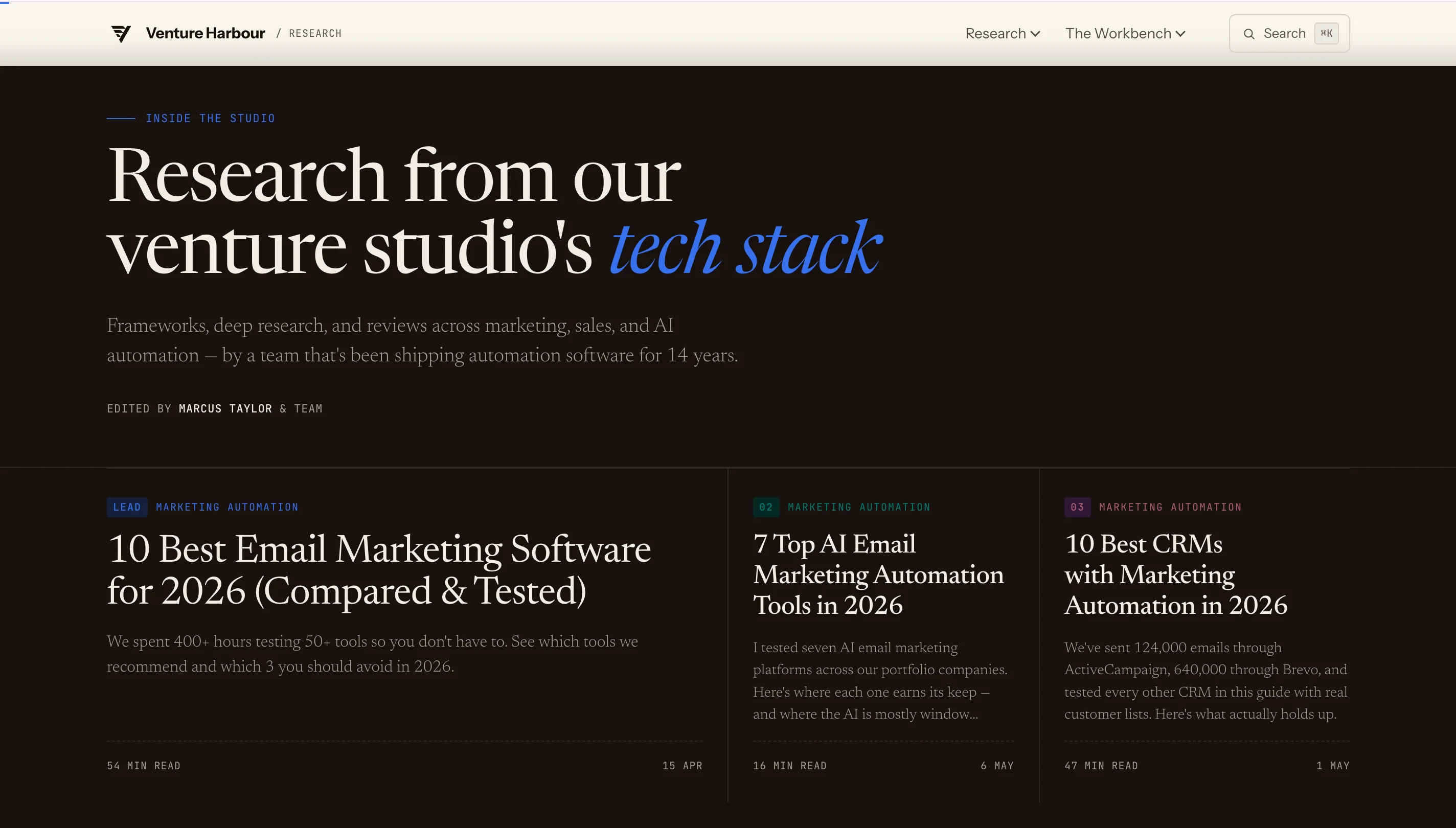
Publishing original research is one of the most effective ways to build authority in B2B content marketing, but it is also one of the most underused. Most companies cite other people's data. The companies that publish their own data become the source that everyone else cites.
Case study example: Venture Harbour, founded by Marcus Taylor, has built a content strategy centered on data journalism and original research. Their team conducts experiments, surveys, and analyses, and then publishes the findings as in-depth articles. This approach turns their content into a primary source rather than a secondary one, which means other blogs, journalists, and AI-driven answer engines are more likely to reference them.
Similarly, the Content Marketing Institute (CMI) publishes an annual B2B content marketing research report that has become one of the most cited resources in the industry. HubSpot's State of Marketing Report follows the same model. These reports generate backlinks, press coverage, and social shares for months after publication because they contain data that others cannot find anywhere else.
The results: Companies that adopt this approach consistently report higher domain authority, more earned backlinks, and stronger positioning in both SERP and AI-driven results. Gaetano Di Nardi demonstrated a related approach at Sales Hacker, where he grew organic traffic by 268%, from 90,000 to 242,000 monthly visitors in six months, without increasing the content budget. A large part of that growth came from creating data-rich content that earned links from authoritative industry publications.
Why it works for B2B SEO and AEO: Original research gives AI tools something unique to cite. When ChatGPT, Perplexity, or Google's AI Overviews answer a question about B2B marketing benchmarks, they need a source. If your company published the benchmark study, your brand shows up in the answer. This is the core principle behind answer engine optimization (AEO), as described by Aja Frost at HubSpot: make your content easy for AI tools to find, understand, and recommend to users. Original research also directly strengthens your E-E-A-T signals (Experience, Expertise, Authoritativeness, and Trustworthiness), which Google uses to evaluate content quality for ranking.
Rand Fishkin at SparkToro has made a similar argument about what he calls "zero-click content." Even if someone never visits your website, if your data appears in an AI summary or a featured snippet, your brand gets the credit. Publishing original research is the single most reliable way to make that happen.
6. Video marketing and creative storytelling (Volvo Trucks)

B2B video marketing does not have to be a talking head explaining product features. Volvo Trucks proved that with one of the most-watched B2B ads in history.
Case study example: In 2013, Volvo Trucks launched their "Live Test" series on YouTube. The most famous installment featured Jean-Claude Van Damme doing the splits between two reversing Volvo trucks. The campaign was designed to demonstrate the precision of Volvo's dynamic steering system, but it did so through creative storytelling that was genuinely entertaining.
The results: The Van Damme video alone has accumulated over 100 million views on YouTube (source: Volvo Trucks YouTube channel). The entire "Live Test" series generated massive global press coverage and established Volvo Trucks as a brand willing to take creative risks in a category known for conservative marketing. More importantly, it demonstrated a product feature in a way that no whitepaper or spec sheet could.
Why it works for B2B inbound marketing: According to a Brightcove and Demand Gen Report survey, 95% of B2B buyers say video is important in moving a purchase forward. And research from the LinkedIn B2B Institute and the IPA Databank shows that emotional B2B ads are 7x more effective at driving long-term business outcomes compared to purely rational messaging.
Gong uses video differently, publishing short clips from their data analysis that break down what top-performing sales reps do differently. Wistia and Vidyard have built entire product categories around B2B video hosting and analytics. The common lesson is the same: B2B buyers are human beings who respond to stories, humor, and emotion. Companies that treat B2B video like a boring checkbox are leaving significant engagement on the table.
7. Proprietary data as content (Gong)
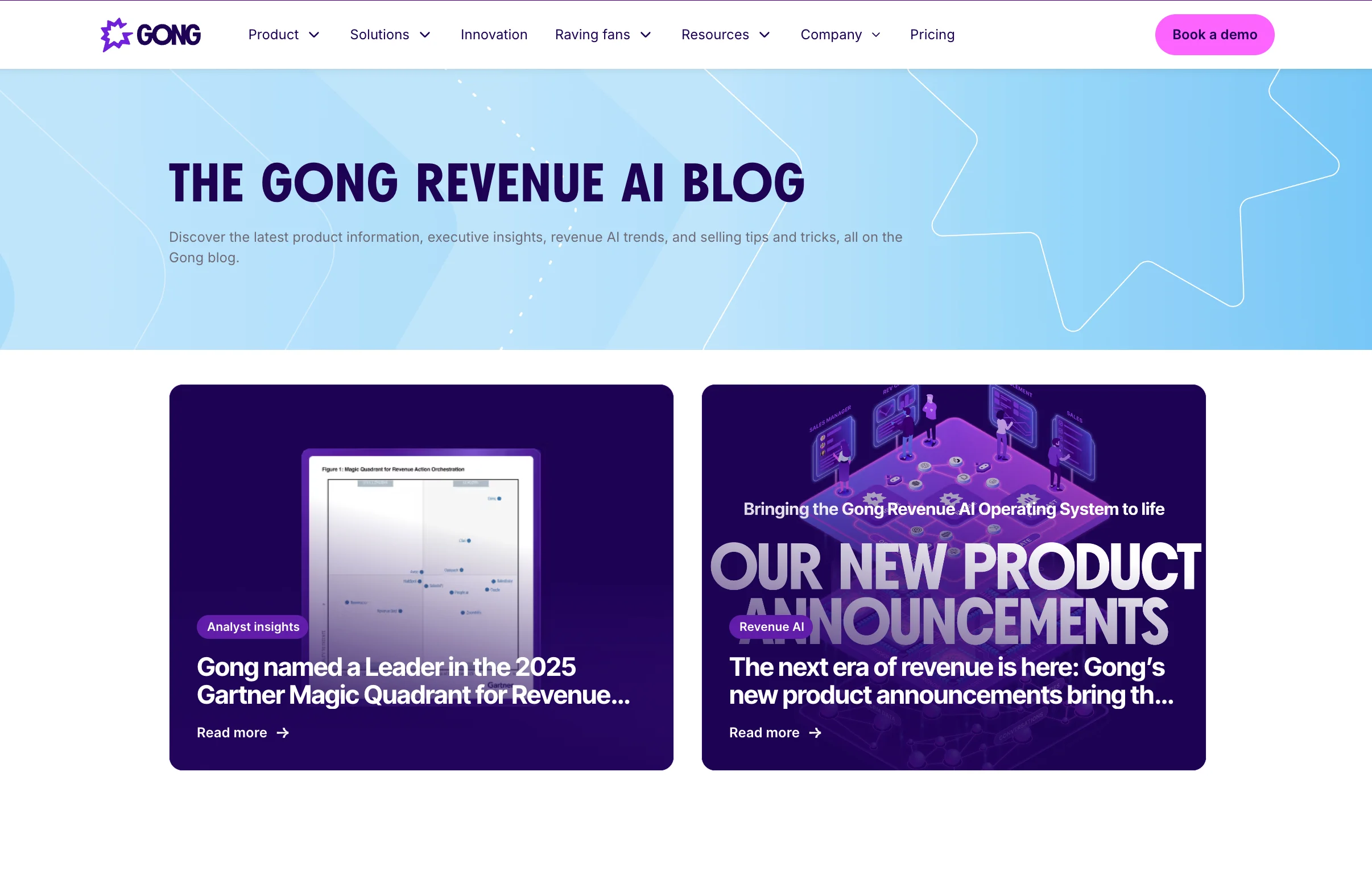
Gong is sitting on one of the most valuable content assets in B2B: a database of millions of real sales conversations, analyzed using their own AI.
Case study example: Gong Labs, the company's research arm, regularly publishes findings from their analysis of real sales calls. These studies cover specific, practical questions: how long should a discovery call be? How many questions should a rep ask? What words do top performers use that average performers do not? Each finding is backed by data from thousands or millions of recorded conversations.
The results: Gong Labs content has become one of the most cited resources in B2B sales and marketing. Their studies are referenced by sales trainers, marketing blogs, podcast hosts, and industry publications because the data is proprietary, meaning no one else can replicate it. This positions Gong not just as a software vendor, but as a research authority in the B2B sales space.
Why it works for B2B content marketing: Most content is a summary of what someone else already said. Gong's content is the original source. This distinction matters for both SEO and answer engine optimization because search engines and AI tools prioritize primary sources over secondary ones. When an LLM needs to answer a question about sales call best practices, it reaches for the source with the data, and that source is often Gong.
If your company collects data through its product, your CRM, or your internal operations, you are sitting on potential content that no competitor can copy. The barrier is not technology. It is willingness to invest the time in analysis and publication.
8. Free tools and interactive content (Ahrefs)
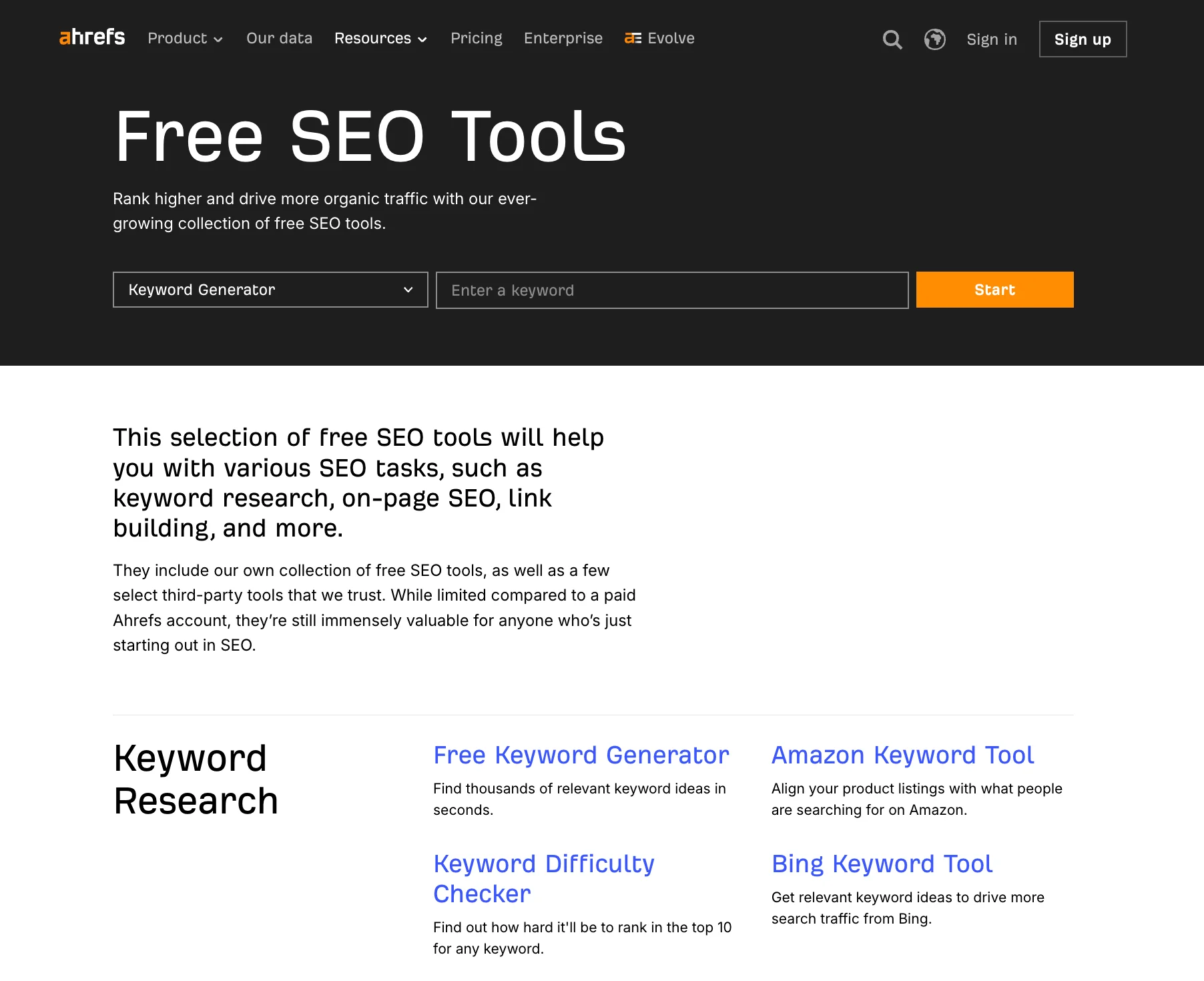
Ahrefs, the SEO toolset, gives away a surprising amount of functionality for free. And that generosity is one of their most effective B2B lead generation strategies.
Case study example: Ahrefs offers free versions of their core tools, such as a backlink checker, keyword generator, website authority checker, and SERP checker. Each of these tools lives on its own landing page, is optimized for a specific high-intent keyword, and delivers genuine value without requiring a login or credit card. HubSpot's Website Grader follows a similar model: enter your URL, get a free audit, and along the way, learn exactly what HubSpot's paid tools can do for you.
The results: According to Ahrefs' own blog, their free tools pages rank for thousands of high-intent keywords and drive a significant portion of their overall organic traffic. The free backlink checker alone ranks for competitive terms that would cost tens of thousands of dollars per month in Google Ads spend. These visitors experience the product's value firsthand, and a meaningful percentage convert to paid plans.
Why it works for B2B inbound marketing: Free tools create what product-led growth advocates call a "value-first" entry point. Instead of asking a prospect to read a blog post about backlink analysis, Ahrefs lets them do the analysis themselves. The experience is inherently more persuasive than any written content because the user sees their own data, their own results, and their own gaps.
This approach also generates natural backlinks. When bloggers and marketers write about SEO, they often link to Ahrefs' free tools as a reference. Those links compound over time, strengthening the domain authority of the pages and helping them rank for even more keywords. Moz and Semrush have adopted similar strategies with their own free tools, which is why this has become one of the most proven inbound marketing examples in the SaaS space.
9. Community building and radical transparency (Buffer)

Buffer built one of the most loyal communities in B2B by doing something most companies would never consider: they published everything.
Case study example: Buffer's Open Blog became famous for publishing internal data that most companies guard closely. This included employee salaries, company revenue, pricing experiments, fundraising details, and even the internal discussions behind major decisions. Alfred Lua, who was part of Buffer's content team, described their philosophy by noting that every company is effectively a media company. Buffer took that idea to its logical extreme by making their own operations the content. Besides this, their discord community keeps on feeding their sense of tight knit.
The results: The transparency strategy generated significant press coverage from outlets like TechCrunch, Inc., Forbes, and Fast Company. Each piece of published data, such as the salary transparency post or the revenue dashboard, earned hundreds of backlinks and thousands of social shares. More importantly, it built a depth of trust with their audience that traditional marketing cannot replicate.
Why it works for B2B inbound marketing: Transparency converts skepticism into loyalty. When a SaaS company publishes its revenue numbers and its failures alongside its wins, it signals honesty in a market full of inflated claims. That trust carries directly into the sales process. Prospects who have followed Buffer's Open Blog arrive with a level of familiarity and confidence that no sales call could produce on its own.
This approach is not for every company. It requires genuine commitment and a culture that supports openness. But for companies willing to share what others hide, it produces inbound results that are difficult for competitors to replicate.
10. Case studies with quantifiable results (Market Veep)
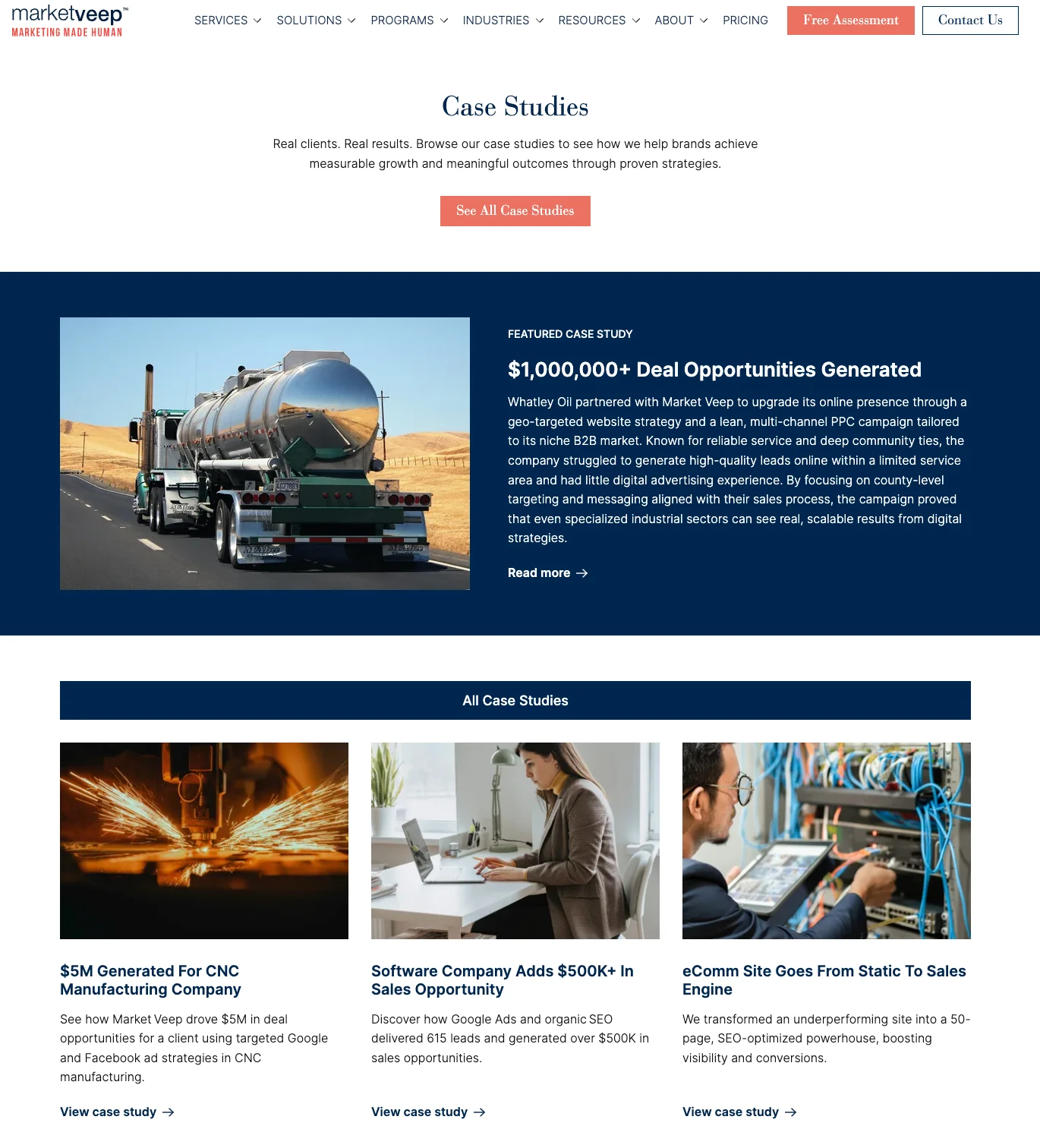
B2B case studies are one of the most consistently effective pieces of inbound content for mid-funnel and bottom-of-funnel buyers. The problem is that most B2B case studies are vague, generic, and unhelpful.
Case study example: Market Veep, a B2B inbound marketing agency, takes a data-first approach to their case studies. Each one follows a structured format: challenge, solution, and quantified result. Instead of writing that a client "saw improved results," they specify the exact metrics, such as percentage increases in traffic, lead volume, and conversion rates. This specificity makes the content credible and useful for prospects evaluating whether the service can deliver similar outcomes.
The results: According to data referenced in Google's AI Overview for this topic, Market Veep's case study approach contributed to a 30% increase in prospect generation. The case studies function as bottom-of-funnel content that supports the sales conversation directly: when a prospect asks "can you do this for a company like mine?", the sales team sends a relevant case study with real numbers.
Why it works for B2B lead generation: A case study with real numbers does more selling than most pitch decks. The reason is simple: prospects trust third-party validation more than first-party claims. When they see that a similar company achieved a specific result, the objection shifts from "can they do it?" to "can they do it for me?", which is a much easier conversation to have.
The framework to follow is straightforward: name the client (or describe their industry and size), describe the specific challenge, explain the strategy, and then report the measurable outcome with exact figures. This is the B2B case study structure that Andrei Zinkevich at FullFunnel.io recommends, and it aligns with how both search engines and AI answer engines prefer to surface proof-based content.
11. Webinars and virtual events (Airmeet)
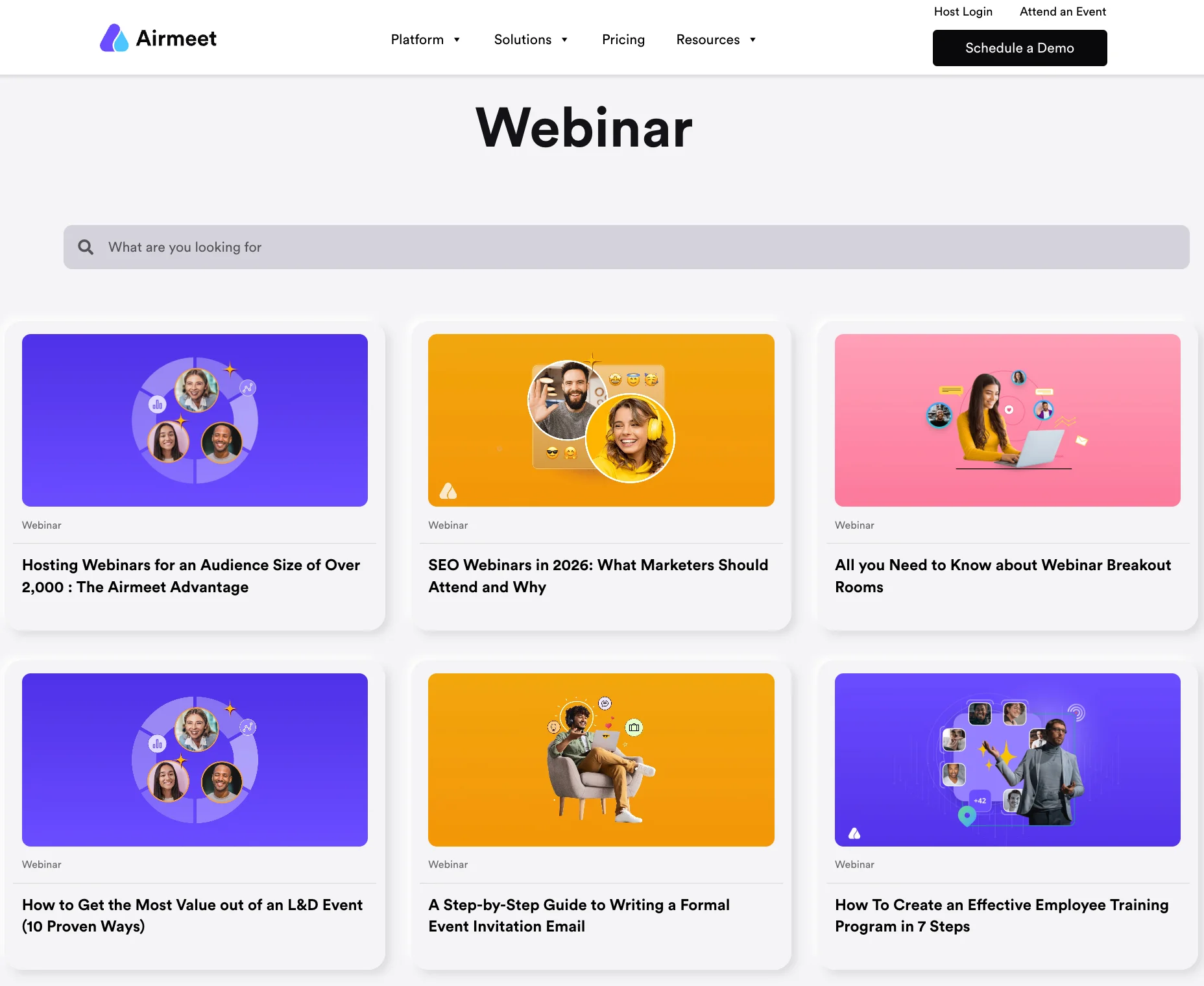
Webinars occupy a unique position in the B2B buyer journey. They combine education with demonstration, and they create a live, two-way interaction that static content cannot match.
Case study example: Airmeet, a virtual events platform, uses its own product as its primary inbound channel. The company hosts regular webinars and virtual summits that address specific industry challenges, such as virtual event engagement, hybrid event best practices, and attendee networking. Each event showcases the platform's capabilities while delivering genuine value to attendees. This is product-led content in event form: the content and the product are the same experience.
The results: Virtual events consistently produce some of the highest conversion rates in B2B marketing for mid-funnel lead generation. Attendees opt in with their email, spend 30 to 60 minutes engaging with the content, and leave with a direct experience of the platform. The lead quality from webinars tends to be higher than from passive content like blog posts because the attendee has invested time and attention.
Why it works as a B2B inbound marketing example: Webinars solve a specific problem in the B2B buyer journey: the gap between "I've read about this" and "I've seen it work." For complex products that require explanation, a live demonstration within an educational context reduces the number of sales calls needed to close. Companies like Salesforce, Adobe, HubSpot, and Monday.com all run extensive webinar programs for this reason.
The key is to make the webinar genuinely educational rather than a disguised sales pitch. If the first 40 minutes are useful even for people who never buy, the last 5 minutes of product context will land with far more credibility. B2B email marketing plays a supporting role here: most webinar registrations come through email nurture sequences that warm up the audience with related content beforehand and follow up with relevant resources afterward. Tools like ActiveCampaign, HubSpot CRM, and Mailchimp help automate these drip campaigns, turning a single webinar into a multi-touch nurture sequence. For collecting registrations, many B2B marketers use Typeform or similar tools to create multi-step signup forms that qualify leads while keeping the experience frictionless.
12. Referral programs and built-in virality (Dropbox)

Dropbox's referral program is one of the most studied growth examples in tech history, and it works as a B2B inbound marketing example because the incentive structure encouraged organic, trust-based sharing rather than paid acquisition.
Case study example: Dropbox offered free storage space to both the person who referred and the person who signed up. The mechanic was simple: share a link, get more storage. This gave every existing user a personal reason to spread the product, and every new user a reason to accept the invitation. The referral was built directly into the product experience, not bolted on as an afterthought.
The results: According to growth expert Sean Ellis and multiple analyses of Dropbox's early growth data, the referral program increased signups by 60%. At its peak, Dropbox was adding millions of users per month, and the referral channel was responsible for a significant share of that growth. The program dramatically reduced Dropbox's customer acquisition cost compared to their earlier experiments with paid advertising, which had been largely unprofitable.
Why it works for B2B referral marketing: Referrals carry built-in trust. When a colleague recommends a tool, you skip the entire "is this credible?" evaluation. That trust transfer reduces the sales cycle and increases conversion rates. For B2B companies, this model works especially well when the product has a natural network effect, meaning it becomes more useful as more people within an organization use it.
Slack, Notion, and Canva have all adapted variations of this approach. The common thread is a product that delivers clear individual value (so the referrer has something worth recommending) and a reward structure that benefits both parties (so there is an incentive to act).
How to measure B2B inbound marketing ROI
Inbound marketing compounds over time, which makes it both powerful and difficult to measure in the short term. A blog post published today might not generate a qualified lead for six months. Here are the metrics that matter most and the tools to track them.
The common mistake is evaluating inbound on a monthly basis using the same metrics you would apply to a paid campaign. Inbound is an investment, not an expense. The right comparison is content marketing ROI measured over 6 to 12 months, not cost-per-click measured over 30 days.
Final thoughts
The 12 B2B inbound marketing examples in this article are tied by a common thread: every one of them is built around giving the buyer something genuinely useful before asking for anything in return. HubSpot gives away education. Slack gives away the product. Gong gives away proprietary data. Buffer gives away internal transparency. Dropbox gives away storage. Each example earns attention first and converts it into revenue later.
That sequencing is significant, because B2B buying behavior has changed permanently. If your brand is not part of that research phase, whether through SEO, LinkedIn thought leadership, webinars, or paid content distribution, you are competing in a race that started without you.
The best B2B inbound marketing strategy is not about picking one channel. It is about finding the 2 or 3 channels where your audience already spends time and investing deeply in them. If you sell to marketers, that might be SEO and LinkedIn. If you sell to developers, it might be free tools and community. If you sell to enterprise buyers, it might be original research and webinars.
Start with the channel closest to your existing strengths, build a system around it, and measure results over quarters, not weeks. Inbound marketing is not fast. But the companies that commit to it build a compounding asset that outbound alone can never match.
You now have the strategy. But most B2B teams get stuck at execution, specifically the creative work. The landing pages, the ad creatives, the video assets, the brand design that makes all of these inbound channels actually convert. That is where a design partner like magier comes in. They work with B2B companies to build the creative layer underneath their inbound strategy, from campaign visuals and landing page design to ad creatives and brand systems.
Frequently asked questions
Does inbound marketing work for B2B companies?
Yes, and the data supports it strongly. HubSpot's State of Marketing Report shows that inbound tactics are 10x more effective for lead conversion than outbound. The Demand Gen Report (2023) confirms that 77% of B2B buyers research independently before contacting sales, making inbound content the primary way to reach them during the research phase.
What are the best B2B inbound marketing channels?
The most effective channels depend on your audience, but the ones with the strongest track records include SEO and educational content, LinkedIn thought leadership, webinars, free tools, video marketing, original research, and paid distribution of inbound content. Companies like Slack, Drift, Volvo Trucks, and Buffer have each proven different channels at scale.
How can B2B companies measure inbound marketing ROI?
Track customer acquisition cost (CAC), MQL-to-SQL conversion rate, organic traffic growth, content-attributed revenue, and email list engagement. Use tools like HubSpot CRM, Google Search Console, Semrush, and Google Analytics. Measure results over 6 to 12 month periods since inbound compounds over time rather than producing immediate returns.
How can a B2B company get started with inbound marketing?
Start by identifying 10 to 15 questions your buyers ask most frequently, using tools like Ahrefs, Semrush, or your own CRM data from sales calls. Then create comprehensive content that answers those questions better than anything currently ranking. Focus on one or two channels first, such as SEO and LinkedIn, and expand once those are producing consistent results.
.png)